Home › Products › Pressure Instruments › Ceramic Pressure Sensor
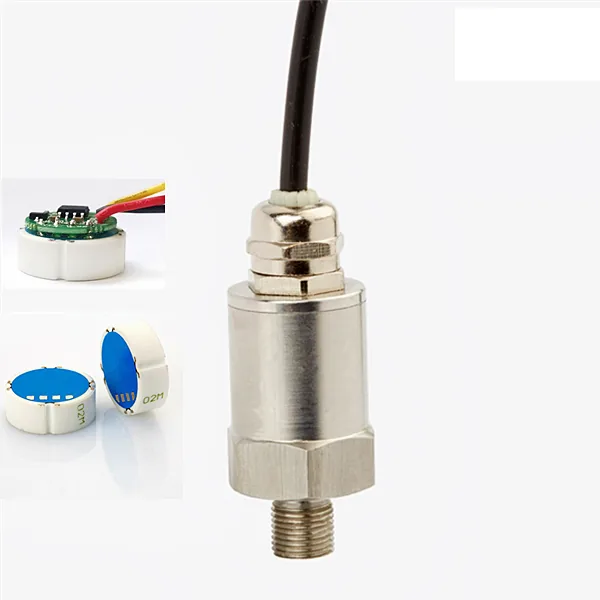
SI-338 Ceramic Pressure Sensor
An alumina-ceramic sensor with the bridge printed straight onto the diaphragm. No fill fluid sits between the media and the cell, so the wetted face shrugs off acids, abrasives and condensate that pit a silicon cell.
- Sensing element: alumina (Al2O3) ceramic, thick-film bridge
- Range: 0-0.2 MPa up to 0-40 MPa
- Accuracy: 0.5%, 1.0% or 2.0% FS
- Output: 4-20 mA, 0-5 V, 0.5-4.5 V (or mV/V cell)
- Operating temp: -20 to 125 °C
- Body / sealing: 304 stainless steel, IP65 / IP67
Overview
Reach for ceramic when the media would attack a stainless or silicon cell, or when the process scuffs and hammers the diaphragm. The SI-338 measures pressure on an alumina (Al2O3) ceramic disc with the sensing bridge fired straight onto the back face. Because alumina is chemically inert and hard, the same wetted part survives weak acids, caustic slurries, refrigerant oil and water-hammer that would pit thin silicon.
Three things decide whether ceramic earns its place: the chemistry touching the diaphragm, the accuracy you actually need, and the temperature swing. Ceramic wins on corrosion and overload; a diffused-silicon pressure transmitter still wins when you need 0.1% FS or better on a clean, benign medium. The SI-338 sits in the 0.5-2% FS band, which covers most OEM, refrigeration and utility pressure points without paying for a metrology-grade cell.
Technical specifications
| Parameter | Specification |
|---|---|
| Pressure range | 0-0.2 MPa, stepped up to 0-40 MPa (gauge or sealed gauge) |
| Comprehensive accuracy | 0.5% FS, 1.0% FS or 2.0% FS (includes non-linearity, hysteresis, repeatability) |
| Sensing element | Alumina (Al2O3) ceramic diaphragm, thick-film printed Wheatstone bridge; element approx. dia. 18 mm |
| Output signal | 4-20 mA (2-wire), 0-5 V, 0.5-4.5 V; bare cell calibrated to 2.0 / 3.0 / 3.3 mV/V |
| Supply voltage | +5 VDC, +12 VDC or +24 VDC (by output) |
| Process connection | G1/4, G1/2, G1/8, M20×1.5, M14×1.5 |
| Electrical connection | Waterproof connector or direct cable lead |
| Compensated temperature | 0 to 65 °C (default) |
| Operating temperature | -20 to 125 °C |
| Overload | Safe 150-200% FS; extreme 200-250% FS |
| Long-term stability | 1% FS / year |
| Response time | Less than 1 ms |
| Housing | 304 stainless steel |
| Protection | IP65 / IP67 (by connection) |
Representative specifications, at room temperature and rated supply unless stated. Values typical; confirm the exact build per datasheet.
Working principle
Pressure acts directly on the front face of the alumina disc and flexes it a few microns. On the back face, resistors printed in thick film form a Wheatstone bridge. As the disc bends, the piezoresistive effect changes those resistors, so the bridge puts out a millivolt signal that tracks pressure and scales with the excitation voltage. Laser trimming sets the zero and span and pins down temperature behavior, which is why the long-term stability holds near 1% FS per year.
The key point for selection: there is no oil-filled isolator between media and cell. A diaphragm-seal or silicon transmitter carries pressure through a fill fluid behind a steel membrane; the SI-338 lets the ceramic itself be the wetted part. That removes a failure mode (fill loss) and lets the inert ceramic face the media, but it also means the ceramic has to be chemically compatible with whatever you run. Check the chemistry first.
Ceramic vs silicon
Pick the cell by the wetted chemistry first, then by accuracy. The table below is the short version we use at the selection desk.
| Factor | Ceramic (SI-338) | Diffused silicon (SI-300) |
|---|---|---|
| Corrosion | Inert alumina face; handles weak acids, caustic, refrigerant oil | 316L or seal needed; corrodes on aggressive media |
| Abrasion / overload | Hard face; safe overload to 150-200% FS | Thin membrane; more sensitive to spikes |
| Accuracy | 0.5-2% FS | 0.3-0.5% FS, smart builds tighter |
| Fill fluid | None; ceramic is the wetted part | Oil-filled isolator behind a steel membrane |
| Best for | OEM, refrigeration, water, mildly aggressive media | Clean process media, tighter accuracy targets |
When even ceramic is not enough, step to a fully isolated build such as a flush-diaphragm pressure sensor with a PTFE-faced or exotic-alloy seal. A US battery-materials plant we supplied measured a pH 14 caustic slurry at 0-30 psi and 20-90 °C; there the answer was a ceramic-and-PTFE wetted path at 0.25% accuracy, because a bare stainless cell would not have lasted. Match the wetted material to the chemistry, not to the catalog photo.
Models and ordering
Configure five things and we build one unit to your point, not a shelf part. The SI-338 is built for OEM volumes too: a UK test-equipment maker took the same cell with a custom thread and their own logo on the housing, set up once and repeated on every order.
| Option | Choices |
|---|---|
| Range | 0-0.2 MPa through 0-40 MPa |
| Accuracy | 0.5% / 1.0% / 2.0% FS |
| Output | 4-20 mA / 0-5 V / 0.5-4.5 V / mV/V cell |
| Process connection | G1/4, G1/2, G1/8, M20×1.5, M14×1.5 |
| Electrical | Waterproof connector or direct lead |
Quote checklist: five things to put in your inquiry
- Media and temperature at the tapping point (the chemistry decides ceramic vs seal)
- Pressure range and whether spikes or water-hammer are expected
- Accuracy target (0.5, 1 or 2% FS)
- Output and supply (4-20 mA / voltage; 12 or 24 VDC)
- Process thread and electrical connection
Ordering example: SI-338, 0-25 MPa, 0.5% FS, 4-20 mA, 24 VDC, G1/4, waterproof connector.
Applications
- Refrigeration and air-compressor pressure, including refrigerant oil contact
- Engine and fuel-pressure measurement on test rigs and OEM assemblies
- Hydraulic and pump pressure where overload spikes are routine
- Water supply, irrigation and HVAC pressure points
- Mildly corrosive chemical and petrochemical service the ceramic can face directly
- OEM instruments needing a compact, low-cost cell with a custom thread or output
Related products
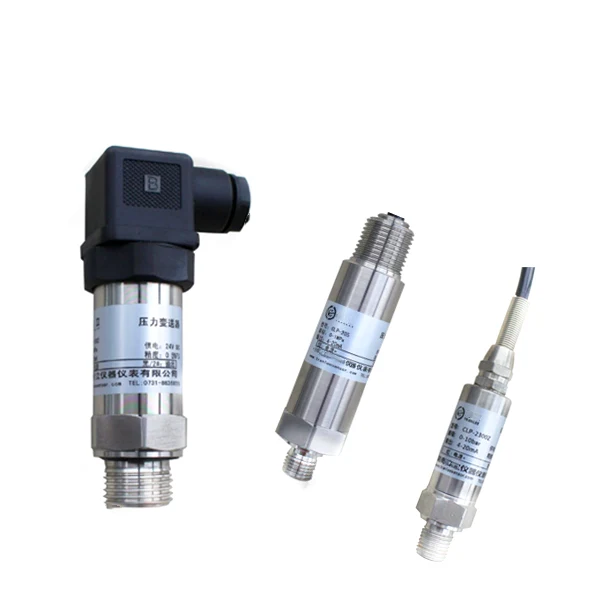
Pressure Transmitters (SI-300)
Diffused-silicon cell for clean process media when you need 0.3-0.5% FS.
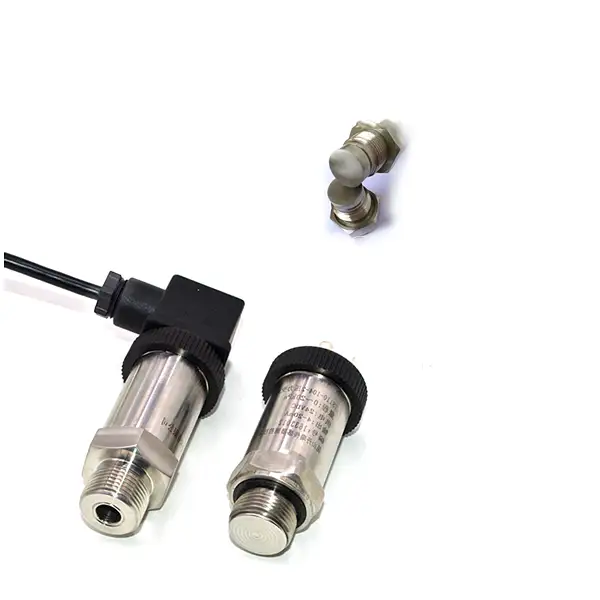
Flush Diaphragm Sensors (SI-703)
Flush steel or PTFE-faced seal for viscous, clogging or strongly corrosive media.
For where a ceramic cell sits in the wider material ladder, the wetted materials guide compares it against 316L and the nickel alloys.
FAQ
What does a pressure sensor do?
It converts pressure into an electrical signal. The SI-338 uses a thick-film resistor bridge on an alumina ceramic diaphragm; pressure flexes the diaphragm, changes the bridge output, and the electronics turn that into 4–20 mA, 0–5 V, or 0.5–4.5 V.
What happens if a pressure sensor is bad?
It reads inaccurately or stops responding, by drifting, sticking at a value, or losing output, which can mislead the control system. A robust ceramic element resists the corrosion and wear that cause early failure, so it stays accurate longer in aggressive media.
What are the types of pressure sensors?
By sensing technology: piezoresistive (diffused silicon), capacitive, ceramic thick-film, strain gauge, piezoelectric, and resonant. The SI-338 is the ceramic thick-film type, chosen because the Al2O3 ceramic resists corrosion and contacts the medium directly without a fill fluid.
Where is a pressure sensor located?
At the process tapping point: it mounts on the pipe, tank, or manifold through its process connection (a threaded port here) so the ceramic diaphragm sees the medium directly.
Request a quote
Tell us the application and we configure one unit, not a shelf part. Send the five points from the checklist above and our engineers will come back with a range, accuracy and connection that fit your point.