Products › Torque Sensors › Rotary Torque Sensors › Micro Torque Sensor
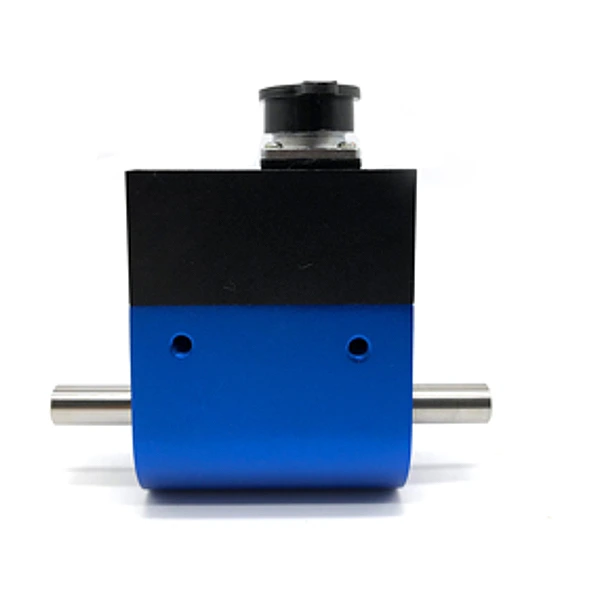
WTQ-1050E Non-Contact Micro Torque Sensor (0.1-5 Nm)
A micro torque sensor measures very small rotational torque, from 0.1 N·m up to about 10 N·m, on a turning shaft. A strain-gauge bridge on a stainless-steel shaft section reads the twist, and the signal is taken off through brushes. It suits micro-motors, viscometers and small gear or actuator tests where a full-size rotary sensor is too coarse.
- Model: WTQ-1050E
- Range: 0.1 N·m to 5 N·m
- Type: non-contact micro, dynamic
- Shaft: keyed both ends, bidirectional
- Build: no slip rings, high-speed
- Accuracy: ±0.1 to ±0.3% FS
Overview
The WTQ-1050E is a non-contact micro torque sensor for small rotating torque, from 0.1 to 5 N·m. It has no slip rings or brushes, so nothing wears and the shaft can turn fast for long periods while the unit reads torque in both directions.
It is the non-contact member of the micro line. For the contact (brush) micro version, or the micro family overview, see the micro torque sensor; for torque above 5 N·m, see the rotary torque sensor.
Features
What sets this micro torque sensor apart:
Non-contact
No slip rings or brushes, so nothing wears during running.
0.1 to 5 N·m
A micro range for small motors, gearheads and instruments.
High-speed
Runs fast for long periods without contact wear.
Keyed both ends
A keyway on each end couples it into a small shaft line.
Bidirectional
Reads torque in both clockwise and counter-clockwise directions.
High accuracy
Non-linearity of ±0.1 to ±0.3% of full scale.
Working principle
A metal-foil bridge on the small shaft strains with torque. Instead of slip rings, the bridge signal crosses to the stationary body without contact, so there is nothing to wear and the shaft can turn fast for long periods. The range stays small, from 0.1 to 5 N·m, and the bridge gives a 1.0-1.5 mV/V signal that an amplifier can turn into a current or voltage output.
Technical specifications
| Parameter | Specification |
|---|---|
| Measuring principle | Non-contact micro dynamic strain-gauge, keyed both ends |
| Model | WTQ-1050E (non-contact micro) |
| Measuring range | 0.1 to 5 N·m |
| Sensitivity | 1.0-1.5 mV/V |
| Non-linearity | ±0.1 / ±0.3% FS |
| Zero output | ±1% FS |
| Hysteresis | ≤±0.05% FS |
| Repeatability | ≤±0.05% FS |
| Response | about 100 microseconds |
| Input resistance | 700 / 750 Ω |
| Insulation resistance | ≥5000 MΩ / 100 VDC |
| Compensated temperature | -10 to 60 °C |
| Operating temperature | -20 to 65 °C |
| Excitation | 10-15 VDC |
| Safe overload | 150% FS |
| Ultimate overload | 200% FS |
| Material | Stainless steel or alloy steel |
Models and ranges
Standard micro rated torques, non-contact, keyed:
| Rated torque | Build |
|---|---|
| 0.1 N·m | Non-contact |
| 0.2 N·m | Non-contact |
| 0.5 N·m | Non-contact |
| 1 N·m | Non-contact |
| 2 N·m | Non-contact |
| 5 N·m | Non-contact |
Non-contact or contact micro
Pick the micro variant by how it runs:
| Model | Range | Choose when |
|---|---|---|
| WTQ-1050E | 0.1-5 N·m | Non-contact, high-speed running with no wear |
| WTQ-1050D | 0.05-5 N·m | Contact (brush), bench and intermittent micro torque |
| Rotary torque sensor | 2 N·m-2 kN·m | Torque above the micro range |
For the contact micro or the family overview, see the micro torque sensor.
Applications
- Small motor and gearhead torque at speed, 0.1 to 5 N·m
- High-speed micro torque with no slip-ring wear
- Instrument and actuator drive torque
- Long-duration micro torque test runs
- Bench and laboratory micro torque references
Challenge: A small motor test ran the shaft fast for long stretches at only a few newton-meters, where a brushed micro sensor would wear.
Solution: A non-contact WTQ-1050E keyed into the line, reading bidirectional torque to 5 N·m with no slip rings.
Result: The micro range gave usable resolution on the small torque, and the non-contact build ran the long, fast cycles without sensor maintenance.
Related products
FAQ
What is the WTQ-1050E torque range?
From 0.1 to 5 N·m. For torque above 5 N·m, use the standard rotary torque sensor.
Is it contact or non-contact?
Non-contact. There are no slip rings or brushes, so nothing wears and the shaft can run fast for long periods. The WTQ-1050D is the contact (brush) micro version.
How does it differ from the WTQ-1050D?
Both are micro sensors. The WTQ-1050E is non-contact (no slip rings) for high-speed running; the WTQ-1050D uses a brush contact for bench and intermittent use.
Request a quote
Tell us the torque range and shaft speed, and we configure one micro torque sensor for your drive, not a shelf part. Send the details and our engineers reply with a specification and quote.