Flow Meters › Coriolis Flow Meters › Low Flow Coriolis Flow Meter
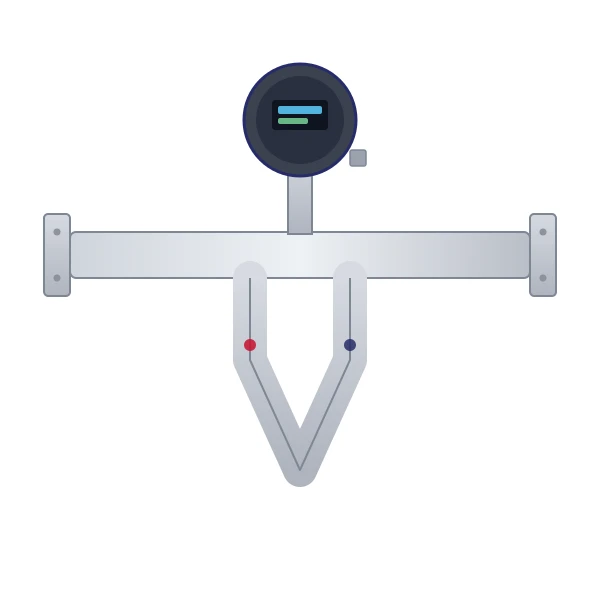
Low Flow Coriolis Flow Meter
A low flow Coriolis flow meter for precise mass metering of very small streams. A triangular DN3 to DN15 measuring tube gives high sensitivity down to a few kg/h, reading mass, density, and temperature directly at 0.1% to 0.5% accuracy, so it suits dosing, additive injection, and fine-chemical and pharmaceutical service.
- Principle: Coriolis, vibrating tube; direct mass and density
- Size: DN3 to DN200
- Accuracy: 0.1% to 0.5% of rate; density ±0.002 g/cm³
- Output: 4-20 mA, pulse, RS-485 Modbus; HART option
- Rating: IP67; Ex d [ia] IIC T6 Gb
Overview
A low flow Coriolis flow meter measures very small mass flows with the same direct Coriolis principle as a full-size meter. A compact triangular DN3 to DN15 measuring tube raises sensitivity so the meter resolves flows down to a few kg/h, while still reading mass, density, and temperature in one instrument at 0.1% to 0.5% accuracy.
Because the reading is true mass and does not drift with pressure, temperature, or density, the low-flow build is used for dosing, additive and catalyst injection, and batching in fine-chemical and pharmaceutical plants. For medium and high flows, use a standard Coriolis mass flow meter; for self-draining sanitary or slurry service, see the straight tube Coriolis flow meter.
Features
Everything here follows from one fact: the meter weighs the flow instead of timing or counting it.
Direct mass measurement
It reads mass flow from the Coriolis force, so the result does not shift with pressure, temperature, or density.
0.1% to 0.5% accuracy
Class 0.1, 0.15, 0.2, and 0.5 are available, with a measurable ratio of 10:1 to 20:1.
Mass, density, temperature
One instrument outputs mass flow, working density to ±0.002 g/cm³, and medium temperature.
Hard fluids and slurries
It measures high-viscosity fluids, grouts, and suspensions that other meters struggle with.
No straight run, no moving parts
It needs no upstream or downstream straight pipe, and there is nothing inside the line to wear.
4-20 mA, pulse, RS-485, HART
An LED or LCD converter drives analog, pulse, and Modbus outputs, with HART on the LCD models.
Working principle
The sensor holds one or two measuring tubes that a drive coil vibrates at their natural frequency. With no flow, both halves of the tube vibrate in step. When fluid flows, each moving mass element resists the change in its direction of motion, and that reaction is the Coriolis force. It acts in opposite directions on the inlet and outlet halves of the tube, so the tube twists, and the two halves move out of step. Position detectors at each end measure this phase, or time, difference. The phase difference is directly proportional to the mass flow rate, while the natural frequency of the tube shifts with the fluid density, so the meter derives both from the same vibrating tube. Sensors from DN20 to DN200 use a U-tube structure; DN3 to DN15 use a compact triangular structure.
Technical specifications
| Parameter | Specification |
|---|---|
| Measurement principle | Coriolis, vibrating tube; direct mass flow, density, temperature |
| Sensor structure | Triangular (bent) tube for very low flow |
| Size | DN3 to DN15 (low-flow range) |
| Flow range | From a few kg/h up to a few hundred kg/h (96 to 144 kg/h at DN3, up to 3,000 to 4,500 kg/h at DN15) |
| Accuracy (mass, liquid) | Class 0.1, 0.15, 0.2, 0.5 (% of rate) |
| Turndown | 10:1 to 20:1 |
| Density measurement | 0.3 to 3.000 g/cm³, accuracy ±0.002 g/cm³ |
| Temperature measurement | -200 to 350 C, accuracy ±1 C |
| Medium temperature | Standard -50 to 200 C; high-temp -50 to 350 C; low-temp -200 to 200 C |
| Ambient temperature | -40 to 60 C (LED), -20 to 60 C (LCD) |
| Working pressure | 0 to 4.0 MPa standard; to 30 MPa on request |
| Wetted material | Measuring tube 316L; housing 304 |
| Connection | Flange, sanitary clamp, or thread (DIN, ANSI, JIS, GB, HG) |
| Outputs | 4-20 mA (load ≥750 ohm) and 0 to 10 kHz pulse; pulse 0.05%, current 0.2% |
| Communication | RS-485 Modbus; HART on LCD models |
| Display | Two-row LED or three-row LCD; mass, volume, density, temperature, totalizer |
| Power | 18 to 36 VDC or 85 to 265 VAC; 7 to 10 W |
| Mounting | Integral or split (2 m signal cable) |
| Protection | IP67 |
| Explosion protection | Ex d [ia] IIC T6 Gb |
Flow ranges by size
The standard flow range is the value recommended for factory calibration and normal operation; the upper-limit range is the maximum for stable sensor operation. Working in the middle third of the standard range gives the best accuracy and the lowest pressure loss.
| Size | Standard flow (kg/h) | Upper limit (kg/h) |
|---|---|---|
| DN3 | 96 | 144 |
| DN6 | 540 | 810 |
| DN8 | 960 | 1440 |
| DN10 | 1500 | 2250 |
| DN15 | 3000 | 4500 |
| DN20 | 6000 | 9000 |
| DN25 | 9600 | 14400 |
| DN32 | 18000 | 27000 |
| DN40 | 30000 | 45000 |
| DN50 | 48000 | 72000 |
| DN80 | 120000 | 180000 |
| DN100 | 192000 | 300000 |
| DN150 | 360000 | on request |
Versions
The sensor and converter are configured to the fluid and the operating point:
- Standard. 316L tube, medium -50 to 200 C, working pressure to 4.0 MPa. The default for most liquids and gases.
- High-temperature. Medium to 350 C, for hot oil and other high-temperature service.
- Low-temperature. Medium to -200 C, for liquid nitrogen, liquid oxygen, and other liquefied gas.
- High-pressure. Working pressure to 30 MPa, for cementing and other high-pressure service.
- Insulation (heat-preserving). A jacketed sensor circulates steam or hot oil to keep media such as asphalt above their solidifying point.
The converter is integral with the sensor, or split with a 2 m cable where the medium is hot or the sensor is hard to read at.
Applications
The low-flow triangular tube suits precise small-stream metering:
- Dosing and additive or catalyst injection in fine chemical plants
- Mass metering of pharmaceutical and biotech process streams
- Flavor, fragrance, and color injection in food and beverage
- Reagent and reactant feed control in small reactors
- Laboratory, pilot-plant, and small-batch blending
Application example
Challenge: A specialty chemical line had to dose a viscous additive at a few kg/h, where a volumetric meter drifted with temperature and could not hold the recipe.
Solution: A low flow Coriolis meter with a triangular tube metered the additive by mass directly, independent of viscosity and temperature.
Result: The dose held to recipe across batches, and the direct mass reading removed the density correction the old meter needed.
Related products
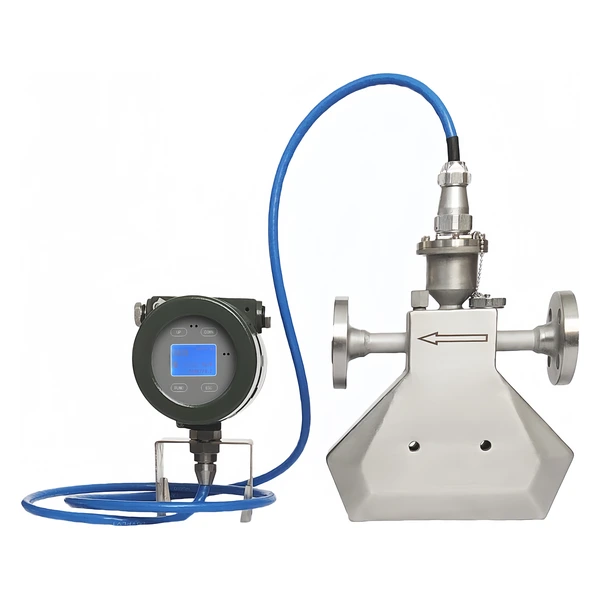 Coriolis Mass Flow Meter
Standard U-tube and triangular builds, DN3 to DN200, for medium and high flows.
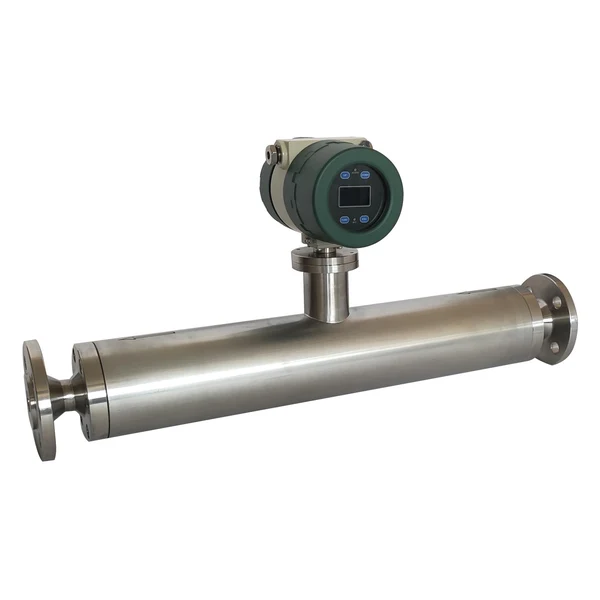 Straight Tube Coriolis Flow Meter
Single straight tube, self-draining, for CIP, slurry, and sticky media.
Charging skids and compressor test stands are typical services for these small sizes; see the guide to metering refrigerant flow for where the meter sits in the circuit.
FAQ
What is a low flow Coriolis flow meter?
It is a Coriolis mass flow meter built with a small triangular measuring tube, typically DN3 to DN15, so it can resolve very low mass flows down to a few kg/h while still reading mass, density, and temperature directly.
How low a flow can it measure?
The triangular DN3 to DN15 tube measures from a few kg/h up to a few hundred kg/h, with full-scale ranges of about 96 to 144 kg/h at DN3 rising to 3,000 to 4,500 kg/h at DN15. Exact ranges depend on fluid and accuracy class.
Why use Coriolis for dosing?
Coriolis reads true mass, so a dose holds to recipe regardless of temperature, pressure, viscosity, or density, with no volume-to-mass correction. That makes the low-flow build well suited to additive and catalyst injection and pharmaceutical batching.
Low flow or standard Coriolis?
Use a low flow meter for small streams down to a few kg/h. For medium and high flows, a standard Coriolis mass flow meter is more economical; for very high flow, see the large diameter Coriolis flow meter.
Request a quote
Send us the fluid, the flow range, the line size, and the temperature and pressure, and we size the sensor and set the converter outputs. Standard, high-temperature, low-temperature, high-pressure, and insulated builds are available.