Flow Meters › Vortex Flow Meters › High Temperature Flow Meter
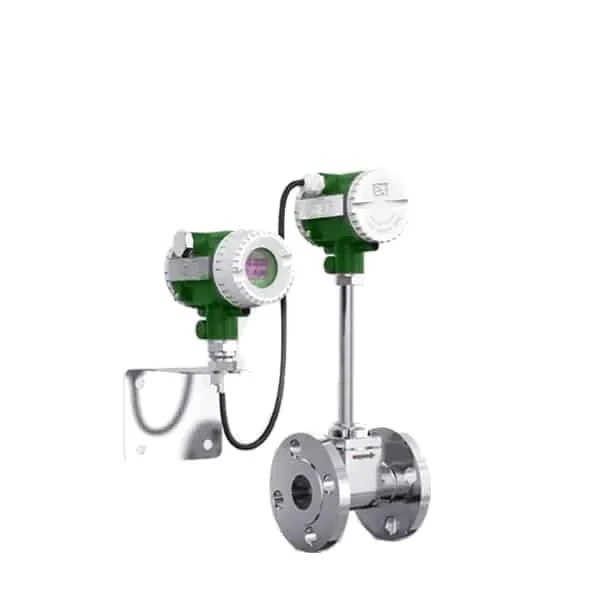
High Temperature Vortex Flow Meter
A vortex flow meter for hot lines, to 400 C. A split converter sits the electronics off the hot pipe on a cable, so the heat that would overheat an integral head stays at the body. It measures superheated and saturated steam, hot gas, and hot liquid, with no moving parts.
- Principle: Karman vortex shedding
- Temperature: to 400 C, split or integral
- Size: wafer or flange DN15 to DN400
- Medium: steam, gas, and liquid
- Output: 4-20 mA, pulse, RS-485; IP65
Overview
A high temperature vortex flow meter measures hot flow that would overheat an ordinary meter. A bluff bar sheds a Karman vortex street, the shedding frequency gives the velocity, and the meter scales it to flow. What lets it run hot is the split converter: the electronics mount away from the pipe on a cable, so the heat conducting up from a 400 C line stays at the body and does not reach the head. The meter has no moving parts, and it measures superheated and saturated steam, hot gas, and hot liquid.
Temperature builds run to 80, 150, 300, or 400 C, so the meter covers a warm line up to a hot main. For a general vortex selection across media, see the vortex flow meter; for steam in particular, with the compensation and sizing that steam needs, see the steam flow meter. This page is for the high-temperature build, where keeping the electronics off the hot line is the point.
Features
Everything here follows from one idea: keep the electronics off the hot line.
Split converter, off the heat
The converter mounts remote on a cable, so heat from the hot line stays at the body, not the electronics.
To 400 C
Temperature builds reach 400 C, for superheated steam, hot process gas, and hot liquid.
Steam, gas, and liquid
One meter measures hot superheated and saturated steam, hot gas, and hot liquid.
No moving parts
A fixed bar in the flow means nothing wears in a hot line, for a long, low-maintenance life.
T and P compensation
Temperature and pressure compensation reports hot steam or gas in mass or standard volume.
4-20 mA, pulse, RS-485
An LCD converter drives analog, pulse, and Modbus, with a 3.6 V lithium battery option.
Working principle
A bluff body, the shedder bar, sits across the bore. As the hot fluid passes it sheds vortices alternately from each side, the Karman vortex street, and the shedding frequency is proportional to the flow velocity. A sensor counts the frequency, and the meter scales velocity to volume flow from the known bore. On a hot line the heat conducts up the meter toward the electronics, so the converter is split off and mounted remote on a cable, where it stays cool. A temperature and pressure input corrects the density to report steam or gas in mass. The shedding needs a developed profile, so 40 diameters of straight pipe upstream and 20 downstream apply.
Technical specifications
| Parameter | Specification |
|---|---|
| Measurement principle | Karman vortex shedding; volumetric, with optional T and P compensation; split converter |
| Medium | Superheated and saturated steam, gas, and liquid |
| Size | Wafer or flange DN15 to DN400 |
| Medium temperature | -40 to 80, 150, 300, or 400 C (by build) |
| Ambient temperature | -20 to 70 C, 86 to 106 kPa |
| Nominal pressure | Liquid 1.6 to 25 MPa; gas and steam 1.6 to 5.0 MPa |
| Accuracy | ±1.0% or ±1.5% of rate |
| Velocity range | Liquid 0.15 to 7 m/s; gas 1.5 to 60 m/s; steam 2 to 70 m/s |
| Converter | Split (remote) on a 10 m cable, or integral |
| Outputs | 4-20 mA; three-wire voltage pulse (high ≥5 V, low <1 V); RS-485 |
| Power | DC 12 V or 24 V; 3.6 V lithium battery for local display |
| Display | LCD: rate, total, vortex frequency, temperature, pressure |
| Straight run | 40D upstream, 20D downstream |
| Protection | IP65 |
| Explosion protection | Intrinsically safe Ex ia IIC T6 Ga |
Representative specifications; confirm per datasheet for the medium, size, and temperature you need.
Ordering example. High temperature vortex flow meter for superheated steam on a DN100 line at 350 C, split converter on a 10 m cable, 4-20 mA and RS-485, flange body.
Split or integral
The converter mounts in one of two ways, and the line temperature decides which:
- Split (remote). For a hot line, the converter sits off the pipe on a cable, up to 10 m, in a cooler, accessible spot. This is what lets the meter run to 400 C without overheating the electronics, and it puts the display where you can read it.
- Integral. For a warm line within the head’s rating, the converter mounts on the body, which is simpler and cheaper where the temperature allows it.
- Steam-specific. For steam metering with the compensation and sizing steam needs, the steam flow meter covers it, in an integral or split build.
Applications
High temperature vortex meters suit hot lines where an ordinary head would overheat:
- Superheated steam mains and turbine steam
- Hot process and flue gas
- Thermal oil and hot heat-transfer fluid
- Reformer, dryer, and furnace gas lines
- Hot process liquid above an integral head’s rating
Application example
Superheated steam main. A plant metering a superheated steam main near 350 C found an integral head ran too hot to last. A split high temperature vortex meter put the body in the steam line and the converter on a wall bracket a couple of meters away on a cable, where it stayed cool and easy to read, and temperature and pressure compensation gave the steam in mass. Moving the electronics off the hot pipe was what kept the meter in service.
Related products
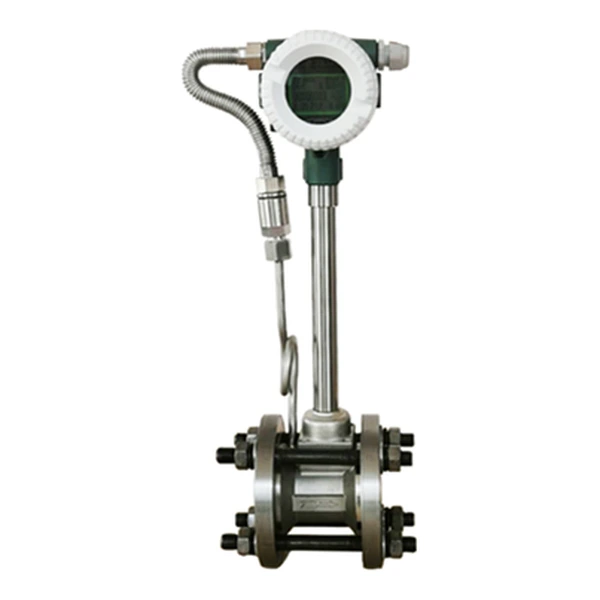 Steam Flow Meter
Vortex steam metering with temperature and pressure compensation.
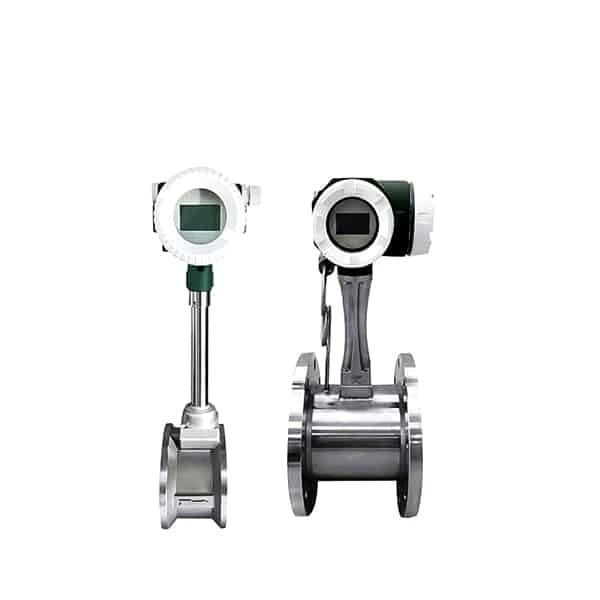 Vortex Flow Meter
General vortex selection for steam, gas, and liquid.
Browse all vortex flow meters →
FAQ
How do you measure high temperature flow?
With a vortex meter built for it: a split converter sits the electronics off the hot pipe on a cable, so the meter runs to 400 C. A bar sheds a vortex street whose frequency gives the flow, and temperature and pressure compensation reports hot steam or gas in mass. The body has no moving parts to fail in the heat.
What flow meter is used for high temperature?
A vortex meter is the usual choice for hot steam, gas, and liquid, because it has no moving parts and a split build keeps the electronics off the heat to 400 C. For higher still, a meter with a cooling element or a different principle is needed; tell us the temperature and we will confirm the build.
Why does a high temperature meter use a split or remote converter?
Heat conducts up the meter from the hot line toward the electronics. A split converter mounts the head away from the pipe on a cable, in a cooler spot, so the electronics stay within their rating. It also puts the display somewhere you can reach and read.
What is the maximum temperature?
Builds run to 80, 150, 300, or 400 C, set at order. The 400 C build with the split converter covers superheated steam and hot process gas; for a warm line within the head’s rating, an integral build is simpler.
How much straight pipe does it need?
40 diameters upstream and 20 downstream, so the flow profile is developed where the bar sheds. Flow conditioners can shorten the upstream run where space is tight.
Request a quote
Send us the medium, the line temperature and pressure, the size, and the flow range, and we set the temperature build, the converter, and the outputs.