Flow Meters › Ultrasonic Flow Meters › Ultrasonic Gas Flow Meter
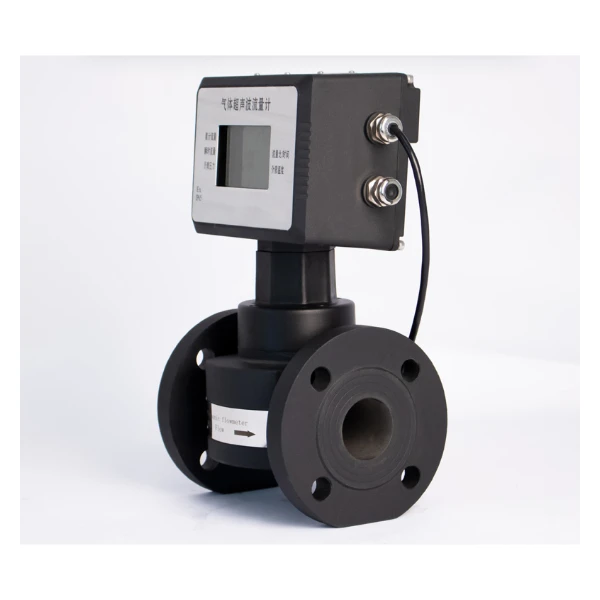
Ultrasonic Gas Flow Meter
A transit-time ultrasonic meter for industrial gases. It reads natural gas, blast furnace and coke oven gas, biogas, flare gas, and compressed air with no moving parts, no pressure loss, and a reading that does not drift with gas composition. Pipe-segment bodies to DN200; insertion probes for larger lines.
- Principle: transit-time ultrasonic (gas)
- Pipe size: DN50 to DN200 inline; larger by insertion
- Accuracy: 1.0% dual channel, 1.5% single channel
- Turndown: up to 60:1; 0.5 to 30 m/s
- Output: 4-20 mA, pulse, RS-485; Ex d mb IIB Gb
Overview
Gas is hard to meter well. It is compressible, often dirty or wet, and its composition can change through the day, which upsets meters that depend on a clean fixed fluid. A transit-time ultrasonic gas meter sidesteps most of that. It sends ultrasonic pulses diagonally across the pipe in both directions and reads flow from the time difference, so there is no orifice to clog, no rotor to wear, and no pressure drop across the meter. The reading does not depend on the gas mixture, which is why this meter is used on blast furnace and coke oven gas, biogas and landfill gas, flare and flue gas, natural gas, and compressed air on the same hardware platform.
It is built to GB/T 18604-2014 and verified to JJG 1030-2007, reads from 0.5 to 30 m/s at 1.0% (dual channel), and ships as an inline pipe-segment body to DN200 or as an insertion probe for larger ducts. For liquid ultrasonic metering use the clamp-on or insertion liquid meters instead; this page is the gas version.
Features
Everything about the design follows from one fact: industrial gas is rarely clean or steady, so the meter has to keep reading through dirt, condensate, and a changing mixture.
No pressure loss
A clear bore means no orifice and no permanent pressure drop, which matters on low-pressure gas.
Composition independent
Reads flow from travel time, so a shifting gas mixture does not bias the result.
Wide turndown
Up to 60:1 across 0.5 to 30 m/s captures low overnight flow and full daytime load on one meter.
Dirt and wet tolerant
Recessed metal transducers and a signal algorithm hold the reading through dust and condensate.
Alarms and diagnostics
Pressure, temperature, signal, and hardware alarms flag a transducer before it needs service.
Inline or insertion
Pipe-segment bodies to DN200, or single and dual-side insertion probes for large ducts.
Working principle
Two transducers sit at an angle across the pipe. Each fires an ultrasonic pulse to the other: the pulse sent downstream is carried by the gas and arrives sooner, while the pulse sent upstream fights the flow and arrives later. The meter measures the difference between the two travel times, which is proportional to the average gas velocity along the path, then multiplies by the pipe area to give volumetric flow. Because the calculation uses only travel time, the result is independent of the gas density and composition, unlike a thermal or differential-pressure meter that has to be told what gas it is reading. A dual-channel build adds a second acoustic path, which averages out flow-profile distortion and tightens accuracy from 1.5% to 1.0%.
Technical specifications
| Parameter | Specification |
|---|---|
| Measurement principle | Transit-time ultrasonic, gas |
| Structure | Pipe-segment (direct) or insertion probe |
| Pipe size | DN50 to DN200 standard; to DN5000 by insertion or custom |
| Channels | Single or dual channel |
| Velocity range | 0.5 to 30 m/s |
| Accuracy | 1.5% single channel; 1.0% dual channel |
| Resolution | 0.001 m/s |
| Repeatability | 1.0 level: 0.2% (Qt to Qmax), 0.4% (Qmin to Qt); 1.5 level: 0.3% / 0.6% |
| Turndown | 30:1 to 60:1 (by size) |
| Low-flow cutoff | Qt = 0.2 Qmax |
| Measuring direction | One-way or two-way |
| Medium temperature | -20 to 60 C |
| Ambient temperature | -25 to 55 C |
| Working pressure | 0 to 1.0 MPa (gauge; absolute on request) |
| Output signal | 4-20 mA, frequency / pulse |
| Communication | RS-485 |
| Power | 24 VDC; starting current ≥2 A, steady <15 W |
| Data storage | 18 months |
| Display and operation | Real-time waveform display, menu interface |
| Alarms | Pressure, temperature, ultrasonic-signal, and hardware-fault alarms |
| Straight run | 10D upstream, 5D downstream |
| Explosion protection | Ex d mb IIB Gb |
| Protection | IP65 |
| Standards | GB/T 18604-2014; JJG 1030-2007 |
Representative specifications for the inline pipe-segment build. Values typical; confirm per datasheet for your gas, size, and certification.
Flow ranges by size
The inline pipe-segment bodies cover these flow ranges at 1.0 MPa with a GB/T 9119 flange. Insertion probes extend the same electronics to larger ducts.
| Size | Turndown | Starting flow (m³/h) | Q min (m³/h) | Q max (m³/h) |
|---|---|---|---|---|
| DN50 (2 in) | 30:1 | 1.4 | 7 | 212 |
| DN80 (3 in) | 33:1 | 3.6 | 12 | 400 |
| DN100 (4 in) | 50:1 | 5.6 | 14 | 700 |
| DN150 (6 in) | 60:1 | 12.7 | 32 | 1900 |
| DN200 (8 in) | 60:1 | 22.6 | 56 | 3400 |
Ordering example. Pipe-segment body, dual channel, DN150, gas group C (blast furnace and coke oven gas), 4-20 mA plus RS-485, Ex d mb IIB Gb.
Pipe-segment or insertion
The same electronics ship in two mounting styles. Pick by pipe size and whether the line can be cut.
| Build | Best for |
|---|---|
| Pipe-segment (flanged spool, DN50 to DN200) | New lines up to DN200; highest accuracy and a factory-set acoustic path |
| Single-rod insertion | Large ducts; lowest-cost hot-tap into an existing line |
| Both-side or same-side insertion (dual path) | Large ducts needing better accuracy than a single rod |
Gas type is part of the order, not an afterthought: the transducer and signal setup differ for clean gases (air, nitrogen, argon), hydrocarbon gases (natural gas, methane, propane), dirty industrial gases (blast furnace, converter, coke oven), and wet exhaust streams (flare, flue, biogas). Tell us the gas and we set the meter for it.
Applications
This meter is built for the gas streams that defeat cleaner-running meters:
- Blast furnace, converter, and coke oven gas metering in steel plants
- Natural gas, coal bed methane, and process gas distribution
- Biogas, landfill gas, and digester gas, including wet and corrosive streams
- Flare gas, flue gas, and vent gas measurement
- Compressed air and clean gases such as nitrogen, oxygen, and argon
Application example
Oil and gas, flare gas metering. An operator needed flare gas flow across a multi-point project, eleven meters in all. Flare gas is the awkward case: low and variable pressure, a composition that shifts with whatever is being relieved, and often wet. Transit-time ultrasonic suited it because it adds no pressure drop, does not need to be told the gas mixture, and holds a wide turndown from a near-idle purge to a full relief event. The operator standardized on a single ultrasonic gas meter type across all eleven points, which simplified spares and training as much as the metering itself.
Related products
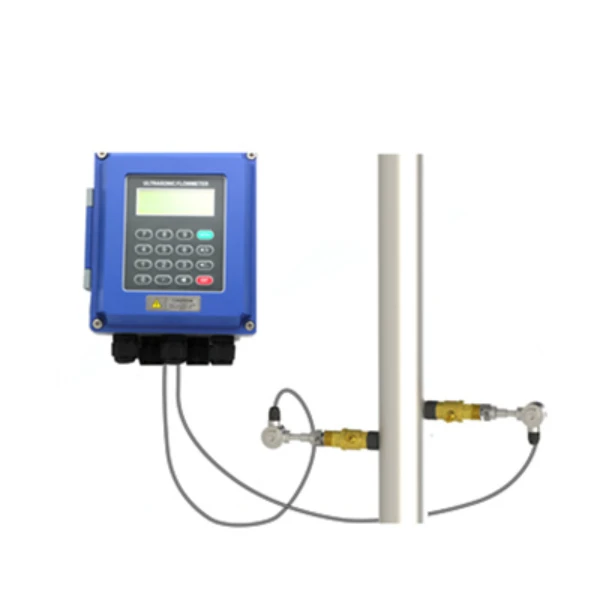 Insertion Ultrasonic Flow Meter
Probe-in-pipe transit-time metering for liquids in large lines.
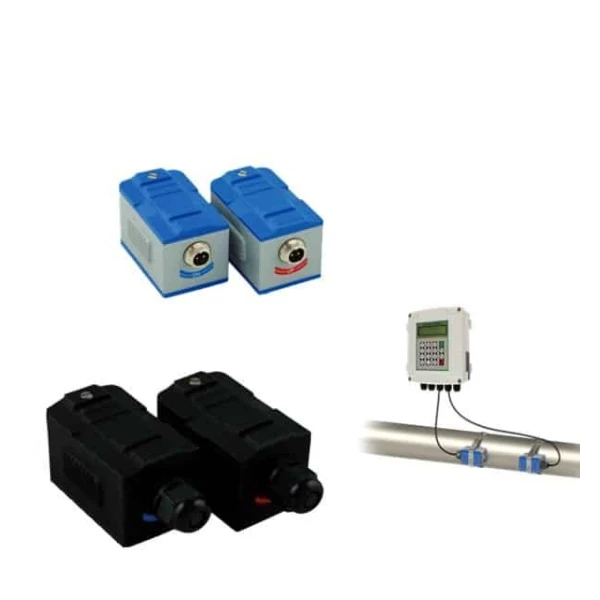 Clamp-On Ultrasonic Flow Meter
Non-invasive transit-time metering for liquids.
Browse all ultrasonic flow meters →
Related applications: Natural gas.
For hydrogen-rich fuel gas such as coke oven gas, the sound-speed setting and the fouling points are covered in our coke oven gas flow measurement guide.
FAQ
How does an ultrasonic gas flow meter work?
Two transducers send ultrasonic pulses diagonally across the pipe, one with the gas flow and one against it. The pulse travelling with the flow arrives sooner; the meter measures that time difference, converts it to average gas velocity, and multiplies by the pipe area to give flow. It uses only travel time, so the reading does not depend on the gas density or mixture.
What gases can an ultrasonic gas flow meter measure?
A wide range: natural gas and coal bed methane, blast furnace, converter, and coke oven gas, biogas and landfill gas, flare and flue gas, compressed air, and clean gases such as nitrogen, oxygen, and argon. The transducer and signal setup are matched to the gas group at the order stage, so the meter is configured for your stream.
How accurate is an ultrasonic gas flow meter?
It reads to 1.5% with a single channel and 1.0% with a dual channel, which adds a second acoustic path to average out flow-profile distortion. Accuracy holds across a turndown up to 60:1, provided the meter has its straight run: 10 pipe diameters upstream and 5 downstream.
Can it measure dirty or wet gas like flare or biogas?
Yes. Recessed metal transducers and a signal-processing algorithm keep the reading through dust and condensate, which is why the meter is used on blast furnace gas, flare gas, and biogas. Very heavy liquid loading or slugging still needs a knockout upstream; tell us the worst-case condition and we confirm the build.
Pipe-segment or insertion: which should I choose?
Use a flanged pipe-segment body up to DN200 for the highest accuracy and a factory-set acoustic path. For larger ducts, or to meter an existing line without cutting it out, use an insertion probe; a dual-side insertion recovers some of the accuracy a single rod gives up.
Request a quote
Send us the gas, the pipe size, the line pressure and temperature, and whether the line is new or existing. We set the channels, the install type, and the gas group, and configure one meter for your stream rather than a generic unit.