Home › Products › Flow Meters › Ultrasonic Flow Meters › Insertion Ultrasonic Flow Meter
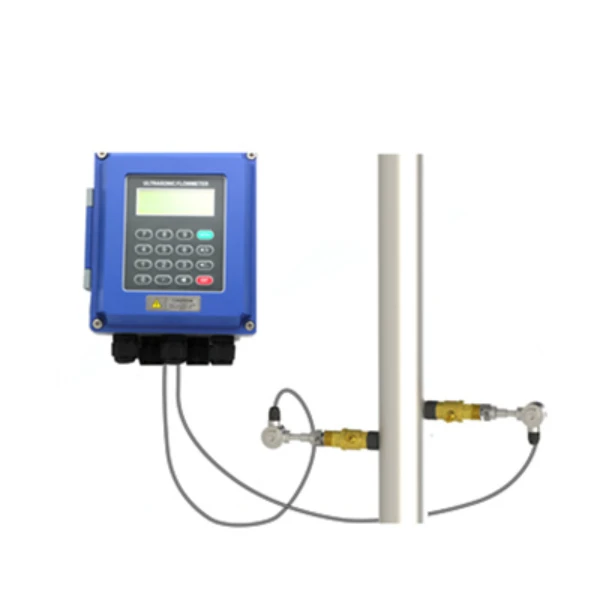
Insertion Ultrasonic Flow Meter (TUF-2000)
A transit-time ultrasonic flow meter with insertion transducers that hot-tap into the pipe. The probes sit just inside the wall, so the signal is strong on large, thick or lined pipes where a clamp-on meter struggles, and the meter installs without cutting the line.
- Principle: transit-time ultrasonic, insertion transducers
- Pipe size: DN50 to DN6000
- Accuracy: plus or minus 1%; repeatability 0.2%
- Fluid temperature: −30 to 160 °C
- Output: 4-20 mA, pulse, relay, RS485; heat/energy option
Overview
An insertion ultrasonic flow meter measures flow by transit time, with the transducers hot-tapped a short way into the pipe rather than strapped to the outside. Sitting just inside the wall, the probes send the signal straight through the flowing liquid, so the reading stays strong on a large, thick-walled or lined pipe where a clamp-on meter loses its echo. The TUF-2000 covers DN50 to DN6000 to plus or minus 1%.
Because the transducers fit through a mounting boss or a hot-tap valve, the meter installs on a pipe that is already in service, with no need to cut the line or empty it. The wall-mounted converter gives 4-20 mA, pulse and relay outputs and RS485, and with a Pt100 pair and the energy option it doubles as a heat meter.
Features
Why an insertion meter suits large and difficult pipes:
Strong signal on big pipes
Probes sit inside the wall, so the signal stays strong on large, thick or lined pipes.
DN50 to DN6000
One converter and transducer pair cover small lines up to a 6 m diameter main.
Hot-tap install
Fit through a boss or hot-tap valve on a live pipe, with no cut and no shutdown.
No pressure drop
The bore stays clear, so there is no obstruction, no wear and no head loss.
Heat / energy option
A Pt100 pair and the energy firmware turn it into a BTU meter for heating and cooling.
4-20 mA, pulse, RS485
Outputs to a PLC or SCADA with RS485 Modbus and on-board data logging.
Working principle
Transit-time flow measurement sends an ultrasonic pulse diagonally across the pipe, once with the flow and once against it. The pulse travelling with the flow arrives sooner; the difference in the two travel times is proportional to the average velocity, and velocity times the pipe area gives the flow. The insertion transducers place the signal path inside the pipe, so the wall and any lining no longer attenuate it.
That is the difference from a clamp-on meter, whose signal must cross the wall twice. On a large, thick or lined pipe the clamp-on echo can be too weak to read, while the insertion probes keep a strong path through the liquid. The method needs a reasonably full pipe of clean, bubble-free liquid, since heavy solids or entrained air scatter the pulse.
Technical specifications
| Parameter | Specification |
|---|---|
| Model / principle | TUF-2000 transit-time ultrasonic flow meter, insertion transducers |
| Pipe size | DN50 to DN6000 (TC-1); DN80 to DN6000 (TC-2 lengthened) |
| Accuracy / repeatability | Plus or minus 1% (battery supply plus or minus 2%); repeatability 0.2% |
| Fluid temperature | −30 to 160 °C (transducer) |
| Analog output | 1 x 4-20 mA (0 to 1 k ohm), accuracy 0.1% |
| Pulse / relay | 1 x OCT pulse; 1 x relay output |
| Signal input | 3 x 4-20 mA input; Pt100 pair for heat / energy |
| Communication | Isolated RS485; Modbus and M-Bus |
| Display / logging | Backlit LCD; logs 512 days and 128 months of totals |
| Converter mounting | Wall, panel or cast-aluminum enclosure |
Insertion or clamp-on
Both are transit-time meters; the transducer is what differs. Choose clamp-on when the pipe is small to medium, the wall is thin and you want nothing touching the liquid. Choose insertion when the pipe is large, the wall is thick or lined, or a clamp-on signal is too weak to hold, since the probes sit inside the wall and keep a strong path. For a metered, in-line custody point a full-bore inline ultrasonic or another technology may suit better, and we will say so.
Installation
Fit the transducers through a mounting boss or a hot-tap valve, one upstream and one downstream at the angle the meter sets, on a clear straight run of at least ten diameters upstream and five downstream. Enter the pipe size, wall and liquid in the converter so it computes the path, then route the cables to the wall unit and wire the 4-20 mA or RS485 output. Confirm the signal strength reads strong before sealing the taps.
Applications
- Large raw-water, cooling-water and distribution mains
- Thick-walled or lined pipes where clamp-on signal is weak
- HVAC chilled and hot water, with the energy option
- Treated water and effluent in big municipal lines
- Live pipes retrofitted by hot-tap without shutdown
A large cooling-water main was too thick-walled for a clamp-on meter to hold a signal, and the line could not be shut down to cut in a full-bore meter. Insertion transducers were hot-tapped into the live pipe, one upstream and one downstream, and the converter read flow at plus or minus 1% with no break in service and no obstruction in the bore.
Related products
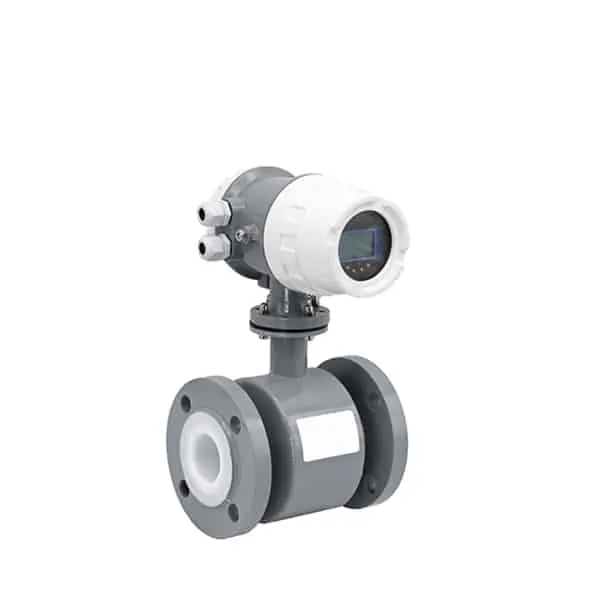 Magnetic Flow Meter
Full-bore mag meter for conductive water, slurry and chemicals, no obstruction.
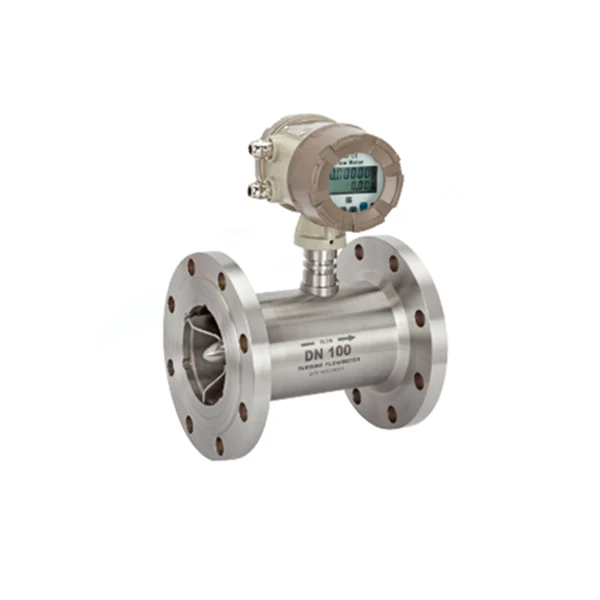 Turbine Flow Meter
Clean low-viscosity liquids (LWGY), high accuracy with a pulse and 4-20 mA output.
Browse all ultrasonic flow meters →
FAQ
How does an insertion ultrasonic flow meter work?
It measures by transit time: an ultrasonic pulse is sent across the pipe with the flow and against it, and the difference in travel time gives the velocity, which times the pipe area gives the flow. The transducers insert a short way into the pipe so the signal path is inside the wall.
What is the difference between insertion and clamp-on ultrasonic?
Both are transit-time meters. A clamp-on straps to the outside and its signal crosses the wall twice; an insertion meter places the probes inside the wall. On a large, thick or lined pipe the insertion probes keep a strong signal where clamp-on can lose it.
How accurate is an insertion ultrasonic flow meter?
The TUF-2000 holds plus or minus 1% with 0.2% repeatability on a full pipe of clean liquid, with a straight run of about ten diameters upstream and five downstream. A battery-powered build is plus or minus 2%.
Can it be installed without shutting down the pipe?
Yes. The transducers fit through a mounting boss or a hot-tap valve, so they go into a live, pressurised pipe with no cut and no shutdown, which is a main reason insertion meters are used on large mains.
Request a quote
Tell us the pipe size, wall and lining, the liquid and whether you need energy, and we configure one meter for the line, not a shelf part.