Home › Products › Level Instruments › Radar Level Sensors › Long-Range Radar Level Sensor
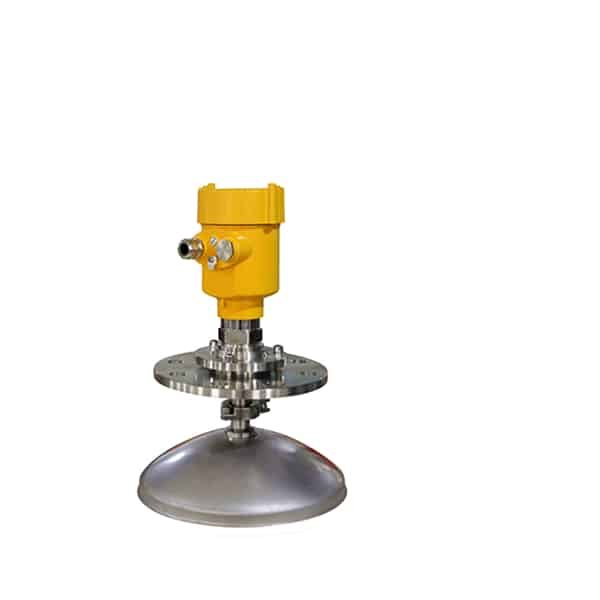
Long-Range Radar Level Sensor (SIRD-904)
A 26 GHz radar with a parabolic antenna that focuses the beam for a range to 80 m. The tight beam reads bulk solids in tall, dusty silos and mines where a horn antenna runs out of reach, without contact and with an explosion-proof build.
- Range: to 80 m (parabolic antenna, 26 GHz)
- Medium: bulk solids, strong dust, crystallizing or condensing
- Process temperature: −40 to 130 °C (250 °C high-temp)
- Accuracy: plus or minus 15 mm
- Output: 4-20 mA / HART / RS485; Ex option
Overview
A long-range radar level sensor reaches the bottom of a tall silo or mine that a standard radar cannot. The SIRD-904 uses a parabolic antenna to focus the 26 GHz beam into a narrow cone, which carries the energy down a long drop and returns an echo from a distant solid surface, to a range of 80 m. Because the beam is tight, it aims past the silo wall and structure and reads through heavy dust.
The measurement is non-contact, so abrasive or dusty bulk solids never touch the sensor, and an explosion-proof build makes it safe in a grain or coal silo. It holds plus or minus 15 mm, outputs 4-20 mA, HART or RS485, and a high-temperature build covers hot solids to 250 °C. It also suits crystallizing and condensing media where buildup defeats a contact probe.
Features
Why a parabolic 26 GHz radar suits long, dusty drops:
Range to 80 m
A parabolic antenna focuses the beam so it reaches the bottom of a tall silo or shaft.
Tight beam
The narrow cone aims past the wall, ladders and structure of a silo to read the solid surface.
Reads through dust
Radar carries through heavy dust raised by filling, where optical and some ultrasonic sensors fail.
Non-contact
No probe in the solid, so abrasion, buildup and crystallizing media cannot foul the sensor.
Explosion-proof option
Exia IIC T6 and Exd IIC T6 builds for grain, coal and other dust-hazard silos.
4-20 mA / HART / RS485
Loop-powered with HART or RS485 Modbus, plus a local LCD and an IP67 housing.
Working principle
The sensor emits a 26 GHz pulse and times the echo from the solid surface; level is the silo height minus the measured distance. The parabolic antenna is a dish that collimates the beam into a narrow cone, which concentrates the energy and carries it far down the silo, so a distant or weakly reflecting solid still returns a usable echo. The narrow cone also keeps the beam off the wall and internal structure.
Bulk solids form a sloped, uneven surface that scatters the echo, so the software tracks the strongest return and maps fixed reflectors such as a fill pipe or a beam. Heavy dust during filling attenuates the signal, but radar passes through it far better than light or sound, which is why a focused radar is the tool for a tall, dusty silo.
Technical specifications
| Parameter | Specification |
|---|---|
| Model | SIRD-904 radar level gauge, parabolic antenna |
| Applicable medium | Bulk solids, strong dust, crystallizing and condensing media |
| Measuring range | 80 m |
| Frequency / antenna | 26 GHz; parabolic (stainless steel) |
| Accuracy | Plus or minus 15 mm |
| Process temperature | −40 to 130 °C standard; −40 to 250 °C high-temperature |
| Process pressure | −0.1 to 0.3 MPa |
| Output / display | 4-20 mA / HART / RS485 Modbus; four-digit LCD |
| Power supply | Two-wire DC 24 V; four-wire DC 24 V or AC 220 V |
| Protection / Ex | IP67; Exia IIC T6 Ga / Exd IIC T6 Gb |
| Connection | Thread or universal flange; aluminum, plastic or stainless housing |
Selecting a long-range radar
The antenna sets the reach. A horn antenna serves most tanks to 20 or 30 m; for a tall silo or a deep shaft the parabolic dish of the SIRD-904 focuses the beam to 80 m. For very fine powder where the dielectric is low, an 80 GHz radar narrows the beam further still and may read a weaker surface better. For a hot product choose the 250 °C build. Where the silo is short or the surface is liquid and clean, a standard horn radar is the simpler choice.
Installation
Mount the dish on the silo roof aimed straight down at the heap, clear of the fill stream, the wall and any internal structure, and keep the beam off the angle of repose where it can. Allow the blanking distance below the antenna and set the silo height. Map fixed reflectors such as a fill pipe, beam or ladder with the echo software, and use the explosion-proof entry and gland in a dust-hazard area.
Applications
- Tall cement, clinker, fly-ash and aggregate silos
- Grain, feed and flour silos in hazardous areas
- Coal, coke and mineral bunkers and bins
- Mine shafts and deep stockpile bins
- Crystallizing and condensing process vessels
Challenge: A bulk-materials operator needed level in tall, dusty silos in a dust-hazard area, where the drop was too long for a horn radar and the dust during filling blinded other sensors.
Solution: Long-range parabolic radar gauges on the silo roofs, explosion-proof and aimed down the heap, with the echo mapping set to ignore the fill pipe and structure.
Result: Non-contact level read to the bottom of the silos through the dust, with nothing in the solid to abrade or foul.
Related products
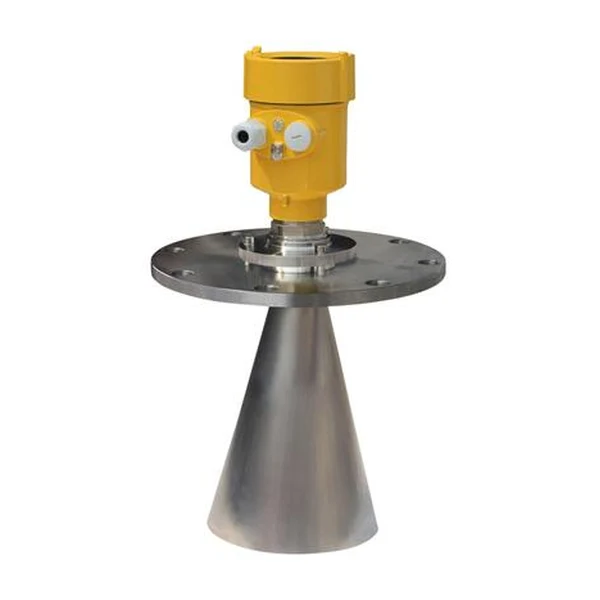 Radar for Solids
6 GHz radar (SIRD-804) for powders, grain and aggregate in bins and silos.
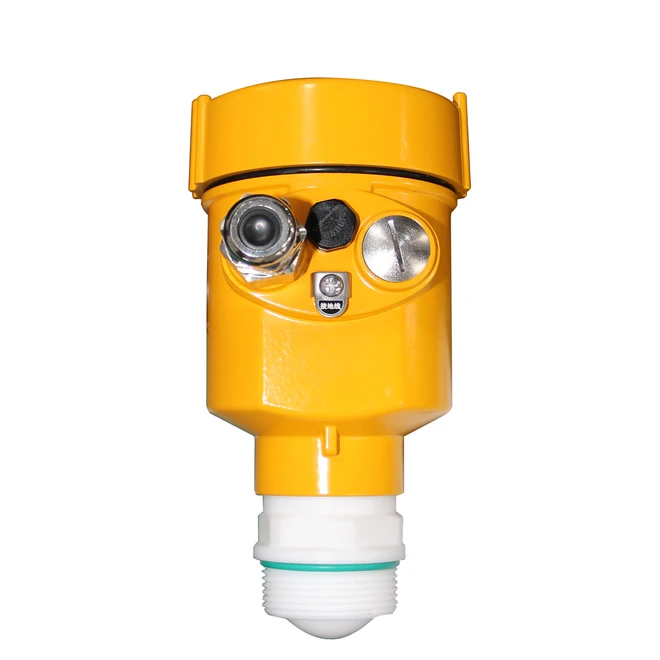 80 GHz Radar Level Transmitter
80 GHz radar with a very narrow beam for fine powder and tall, narrow silos.
Browse all radar level sensors →
FAQ
How does a long-range radar level sensor work?
It sends a 26 GHz pulse and times the echo from the surface; level is the silo height minus the measured distance. A parabolic antenna focuses the beam into a narrow cone, which carries the energy down a long drop and returns an echo from a distant solid, to 80 m.
Can radar measure level in a tall, dusty silo?
Yes. Radar passes through heavy dust far better than light or sound, and the parabolic dish concentrates the beam so it reaches the bottom of a tall silo. The narrow cone also aims past the wall and structure to read the solid heap.
How accurate is a long-range radar level sensor?
The SIRD-904 holds plus or minus 15 mm over its 80 m range. A solid heap is sloped and uneven, so the software tracks the strongest echo; siting the antenna over the heap and mapping fixed reflectors keep the reading steady.
What are the disadvantages of radar level sensors?
A very steep angle of repose, strong fixed reflectors near the beam, or an extremely low-dielectric powder can weaken the echo. Aiming the dish over the heap and using the echo mapping handle most cases; for the finest powders an 80 GHz radar is the better choice.
Request a quote
Tell us the silo height, the material and its dust and dielectric, the temperature and the area classification, and we configure one radar for the silo, not a shelf part.