Home › Products › Level Instruments › Ultrasonic Level Sensors › Ultrasonic Level Detector
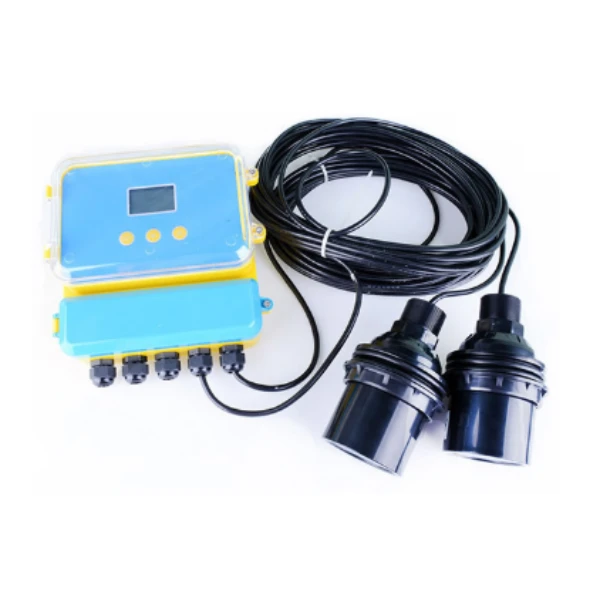
Ultrasonic Level Detector and Controller (ULT-200)
A split-type ultrasonic level detector that reads liquid level without contact and switches built-in relays to control pumps and alarms. A remote probe on up to 100 m of cable mounts over a wet well or tank while the display and relays sit in the control room.
- Type: split detector, remote probe to 100 m of cable
- Range: 5 to 70 m (probe dependent)
- Control: programmable relays for pump start/stop and high/low alarm
- Output: 4-20 mA and RS485 / RS232
- Protection: probe IP68, transmitter IP65
Overview
The ULT-200 is a split-type ultrasonic level detector that both measures level and controls equipment. A remote probe mounts over the water on up to 100 m of cable, and the wall-mounted unit holds the display, the 4-20 mA output and the relays. Because it is non-contact, the probe never touches the liquid, so there is nothing in a wet well or sump to foul, and a split build keeps the electronics out of the wet, hazardous pit.
What sets a detector apart from a plain transmitter is the built-in control. Programmable relays start and stop a pump at set levels and raise a high or low alarm, so the ULT-200 runs a lift station or a fill-and-empty tank on its own, while the 4-20 mA and RS485 outputs report level to a PLC or SCADA. It covers ranges from 5 to 70 m depending on the probe.
Features
Why a split ultrasonic detector suits level control:
Built-in relays
Programmable relays start and stop a pump and raise high or low alarms with no separate controller.
Remote probe to 100 m
The probe mounts over the well on up to 100 m of cable, keeping the display in a dry panel.
Non-contact probe
The IP68 probe reads through the air gap, so nothing in the sump or wet well fouls it.
4-20 mA and RS485
Reports level to a PLC or SCADA over 4-20 mA, with RS485 or RS232 Modbus as well.
Range to 70 m
Probe options cover 5 to 70 m, from a shallow sump to a deep reservoir or tank.
Local LCD
A four-digit LCD shows level and setpoints, with mains or 24 V DC supply options.
Working principle
The probe sends an ultrasonic pulse down to the liquid surface and times the echo back; level is the mounting height minus the measured distance. The detector compares that level against the relay setpoints and switches a pump or an alarm when the level crosses a point, so the same instrument that measures also controls. The split build connects the probe to the wall unit on a cable up to 100 m.
Ultrasonic measurement needs an air path and a clear surface, so it suits open wells, sumps and vented tanks. Heavy foam, thick vapor or steam absorb the pulse, and a turbulent surface scatters it, so for those a radar detector is the better choice. A blanking distance below the probe sets the closest level it can read.
Technical specifications
| Parameter | Specification |
|---|---|
| Model / type | ULT-200 split-type ultrasonic level detector |
| Measuring range | 5, 10, 15, 20, 30, 40, 50, 60, 70 m (by probe) |
| Accuracy / resolution | 1% to 2%; resolution 5 mm or 0.5% |
| Analog output | 4-20 mA, 750 ohm load |
| Relay output | Two groups, AC 250 V / 8 A or DC 30 V / 5 A, status programmable |
| Communication | RS485 / RS232 (optional) |
| Display | Four-digit LCD |
| Power supply | 220 V AC 50 Hz standard; 24 V DC or battery optional |
| Ambient temperature | Transmitter −20 to 60 °C; probe −20 to 80 °C |
| Probe cable | Up to 100 m (10 m standard) |
| Protection | Probe IP68; transmitter IP65 |
Selecting a detector or a transmitter
Choose by what the instrument has to do. If you only need a 4-20 mA level signal to a PLC, a plain ultrasonic level transmitter is enough. If the instrument itself has to switch a pump or sound an alarm at set levels, the ULT-200 detector adds the relays to do it without a separate controller. Pick the probe by range, 5 to 70 m, and mount it on the cable length the site needs. Where foam, steam or a turbulent surface defeat ultrasound, a radar detector is the better choice.
Installation
Mount the probe over the liquid, aimed straight down and clear of the inflow, the pump and the wall, above the highest level by at least the blanking distance. Run the probe cable back to the wall unit, up to 100 m, and wire the relays to the pump starter and the alarm. Set the range, the blanking distance and the relay setpoints, and confirm the pump duty and standby points switch as the level rises and falls.
Applications
- Lift-station and sump wet wells with pump control
- Water and wastewater tanks and reservoirs
- Fill-and-empty process and storage tanks
- Open channels and basins
- Remote sites reporting level to SCADA
A lift-station wet well runs two pumps in duty and standby. A split ultrasonic detector mounts its probe over the pit on the cable run back to the panel, and its two relays start the duty pump at the high level, stop it at the low level and call the standby pump on a high-high alarm, while the 4-20 mA output trends the level to SCADA, with no probe in the pit to foul.
Related products
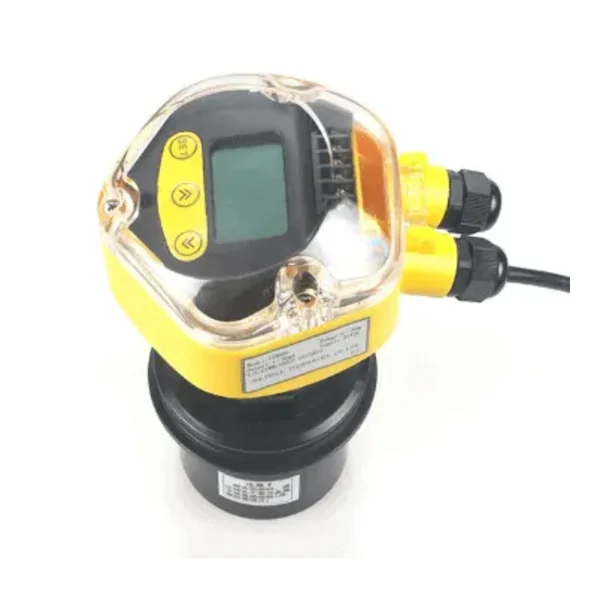 Ultrasonic Level Transmitter
Integral ultrasonic transmitter (ULT-100A) for a continuous 4-20 mA level signal.
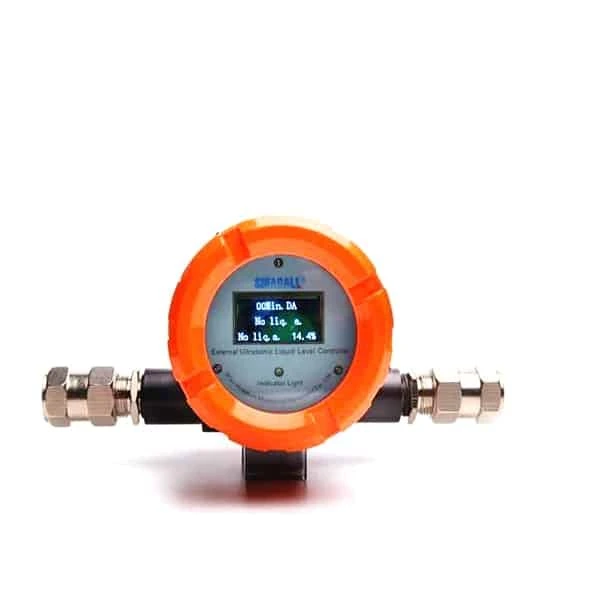 Ultrasonic Level Switch
Non-contact point switch for a single high or low level alarm.
Browse all ultrasonic level sensors →
FAQ
What is an ultrasonic level detector?
It is an ultrasonic level instrument that both measures level and switches relays to control equipment. The ULT-200 reads the surface with a remote probe and uses programmable relays to start and stop a pump or raise an alarm, while also giving a 4-20 mA and RS485 signal.
How does an ultrasonic level detector work?
The probe sends an ultrasonic pulse to the liquid surface and times the echo; level is the mounting height minus the measured distance. The detector compares the level against the relay setpoints and switches a pump or alarm when the level crosses a point.
What is the difference between a level detector and a transmitter?
A transmitter gives a 4-20 mA level signal to a PLC. A detector adds built-in relays, so it can switch a pump or alarm on its own without a separate controller. The ULT-200 does both, measuring level and controlling equipment from one unit.
What are the disadvantages of ultrasonic level measurement?
Heavy foam, thick vapor or steam absorb the pulse, and a turbulent surface scatters it, which can weaken the echo. Siting the probe over calm liquid and setting the blanking distance handle most cases; where they cannot, a radar detector is the better choice.
Request a quote
Tell us the range, the cable run to the panel and what the relays must switch, and we configure one detector for the site, not a shelf part.