Products › Torque Sensors › Rotary Torque Sensors › Inline Torque Sensor
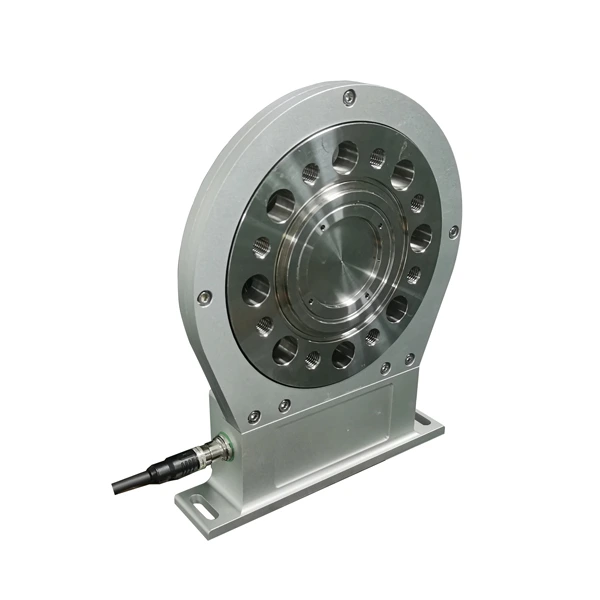
Inline Torque Sensor
An inline torque sensor mounts in the shaft line between a drive and its load and measures the torque passing through. This contactless inline series transmits rotating torque without slip rings, covers 50 N·m to 10 kN·m, and installs in any orientation.
- Model: N40B
- Range: 50 N·m to 10 kN·m
- Type: bearingless disc coupling, contactless
- Speed: up to 30,000 rpm
- Accuracy: ±0.1 to ±0.2% FS
- Install: short length, integrated flexible-disc coupling
Overview
The N40B is an inline torque sensor that bolts straight into the drive line through an integrated dual flexible-disc coupling. It has no bearings, so there is nothing to wear at speed, and the short body fits where a coupling would normally sit.
It measures torque from 50 N·m to 10 kN·m on a rotating shaft and can run to 30,000 rpm. The signal crosses the rotor-to-stator gap without slip rings, and an optional pickup adds speed so the unit reports torque, speed and power.
Features
What sets this inline torque sensor apart:
Bearingless
An integrated flexible-disc coupling carries the load, so there are no bearings to wear or replace.
Inline coupling
Bolts into the drive line in place of a coupling, with a short installation length.
Non-contact
The signal crosses the rotor-to-stator gap with no slip rings, so nothing rubs at speed.
High torque
Covers 50 N·m to 10 kN·m for larger motors, gearboxes and test stands.
Fast running
Runs to 30,000 rpm, with an optional pickup for speed and power.
Stable reading
Zero and span temperature effect stay within ±0.02% FS over the compensated range.
Working principle
Torque applied across the coupling strains a metal-foil bridge bonded to the flexure. The bridge output is carried across the rotor-to-stator gap without contact, so there are no slip rings. Because a flexible-disc coupling carries the shaft load, the sensor needs no bearings. An optional pickup counts shaft rotation at 60 pulses per revolution for speed, and torque multiplied by speed gives mechanical power.
Technical specifications
| Parameter | Specification |
|---|---|
| Measuring principle | Non-contact strain-gauge, bearingless, integrated dual flexible-disc coupling |
| Measuring range | 50 N·m to 10 kN·m |
| Accuracy | ±0.1 / ±0.2% FS |
| Repeatability | ±0.02% |
| Zero temperature effect | ±0.02% FS |
| Span temperature effect | ±0.02% FS |
| Compensated temperature | -10 to 60 °C |
| Operating temperature | -20 to 75 °C |
| Maximum speed | Up to 30,000 rpm |
| Speed option | 60 pulses per revolution |
| Torque output | 10 ±5 kHz, 4-20 mA, ±5 VDC, ±10 VDC, RS485, RS232, CAN |
| Supply | 12-24 VDC, under 100 mA |
| Electrical connection | 8-pin |
| Overload protection | 200% FS |
| Installation | Axial offset ±0.2 mm, angle error 0.4° |
| Material | Sensor 17-4PH stainless steel; housing aluminum |
Torque ranges
Standard rated torques, all bearingless and non-contact:
| Rated torque | Maximum speed |
|---|---|
| 50 N·m | 30,000 rpm |
| 100 N·m | 30,000 rpm |
| 200 N·m | 30,000 rpm |
| 500 N·m | 30,000 rpm |
| 1 kN·m | 30,000 rpm |
| 2 kN·m | 30,000 rpm |
| 5 kN·m | 30,000 rpm |
| 10 kN·m | 30,000 rpm |
Bearingless or shaft mount
Pick by how the sensor sits in the drive line:
| Type | Mounting | Choose when |
|---|---|---|
| N40B inline | Integrated disc coupling, bearingless | Short install length, no bearings, high speed |
| Shaft sensor | Keyed shaft, shaft-to-shaft | You couple it through your own couplings |
For a shaft-to-shaft unit, see the rotary torque sensor.
Applications
- Large motor, gearbox and pump test stands
- Drive lines where a coupling already sits and space is short
- High-speed dynamometers up to 30,000 rpm
- Bearingless setups that must avoid added friction
- Torque, speed and power measurement on one shaft
Challenge: An R&D test bench had to measure torque on a motor-and-gearbox shaft from 500 to 1,500 N·m while it ran between 650 and 3,000 rpm.
Solution: An inline disc-coupling torque sensor in that range with a 4-20 mA output, bolted into the drive line in place of a coupling.
Result: The bearingless coupling added no extra bearings to the line, and the 4-20 mA signal reached the bench controller across the full speed range.
Related products
FAQ
What is an inline torque sensor?
It is a rotary torque sensor that mounts in line with the shaft. The N40B uses an integrated flexible-disc coupling, so it bolts into the drive line in place of a coupling.
What torque range does the N40B cover?
Rated capacities from 50 N·m to 10 kN·m, at speeds up to 30,000 rpm.
Does it have bearings?
No. A dual flexible-disc coupling carries the shaft load, so there are no bearings to wear, and the installation length stays short.
Is the N40B contact or non-contact?
Non-contact. The torque signal crosses the rotor-to-stator gap without slip rings, so nothing rubs when the shaft spins.
Request a quote
Tell us the torque range, the shaft and how you mount it, and we configure one inline torque sensor for your drivetrain, not a shelf part. Send the details and our engineers reply with a specification and quote.