Flow Meters › Vortex Flow Meters › Compressed Air Flow Meter
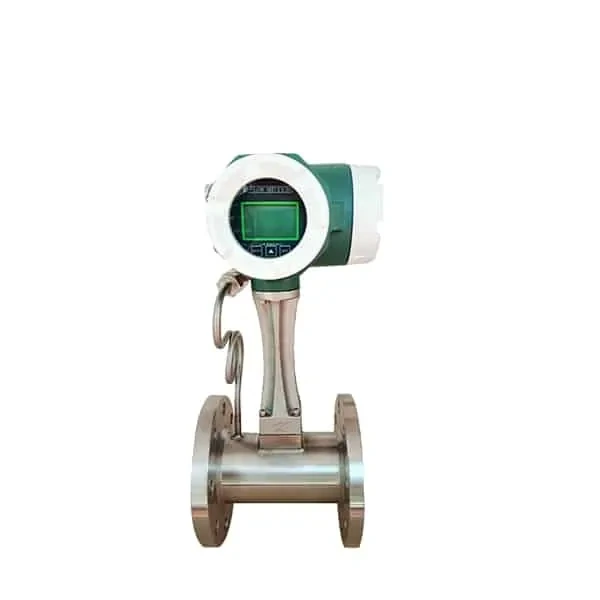
Vortex Compressed Air Flow Meter
A vortex flow meter for compressed air. It counts the vortices a bluff bar sheds into the flow, with no moving parts to wear, and built-in temperature and pressure compensation reports the air in standard volume. It is robust on hot and wet air and suits steady metering of a header or main.
- Principle: Karman vortex shedding
- Size: DN15 to DN600, wafer, flange, or insertion
- Accuracy: 1.0% or 1.5% of rate
- Compensation: optional built-in T and P, standard volume
- Output: 4-20 mA, pulse, RS-485; IP65
Overview
A vortex compressed air flow meter measures air by counting the vortices a bluff bar sheds into the flow. The shedding frequency gives the velocity, and the meter scales it to volume; because air density moves with temperature and pressure, built-in temperature and pressure sensing corrects it and reports the air in standard volume, in Nm3/h. There are no moving parts to wear, and the meter takes hot and wet air, so it is a robust choice for steady metering of a compressed-air header or main where you want a cost or energy total.
It is not the meter for everything air. A vortex meter needs a minimum velocity to shed cleanly, so it is weak at very low flow, which makes it a poor leak detector. For low overnight flows, leak surveys, or a very wide turndown, a thermal mass meter reads where a vortex cannot. For a general vortex selection across steam, gas, and liquid, see the vortex flow meter; on a large main, an insertion vortex flow meter meters the duct at a lower cost.
Features
Everything here follows from one job: a robust, no-moving-parts meter for a compressed-air line.
No moving parts, robust
A fixed bar in the flow means nothing wears, and the meter shrugs off hot and wet air.
Standard volume, Nm3/h
Built-in temperature and pressure correct the air density and report a standard-volume total.
Wafer, flange, or insertion
A wafer or flange body to DN300, or an insertion probe for a large main to DN600.
Hot air to 400 C
A high-temperature build reads hot compressed and process air to 400 C, where many meters cannot.
4-20 mA, pulse, RS-485
An LCD head drives analog, pulse, and Modbus, with a 3.6 V lithium battery for a local total.
For energy sub-metering
A standard-volume total per line supports compressed-air cost allocation and energy tracking.
Working principle
A bluff body, the shedder bar, sits across the bore. As air passes it sheds vortices alternately from each side, the Karman vortex street, and the shedding frequency is proportional to the flow velocity. A sensor counts the frequency, and the meter scales velocity to volume flow from the known bore. Air density changes with temperature and pressure, so an integrated temperature and pressure measurement corrects it and gives the flow in standard volume. The bar needs a clean, developed profile and a minimum velocity to shed reliably, so the meter asks for straight pipe and is weak at very low flow.
Technical specifications
| Parameter | Specification |
|---|---|
| Measurement principle | Karman vortex shedding; volumetric, with optional T and P compensation to standard volume |
| Medium | Compressed air and compressed gas |
| Size | DN15 to DN600 |
| Connection | Wafer or flange; insertion for large sizes |
| Accuracy | ±1.0% or ±1.5% of rate |
| Velocity range | 1.5 to 60 m/s (best signal above about 5 m/s) |
| Medium temperature | -40 to 80 C standard; to 400 C high-temperature build |
| Ambient temperature | -30 to 65 C, 86 to 106 kPa |
| Compensation | Optional integrated temperature and pressure, standard volume (Nm3/h) |
| Outputs | 4-20 mA; voltage pulse (high ≥5 V, low <1 V, square wave); RS-485 |
| Power | DC 12 V or 24 V; 3.6 V lithium battery for local display |
| Display | LCD: rate, total, temperature, pressure |
| Straight run | 40D upstream, 20D downstream |
| Protection | IP65 (IP68 for submersible install) |
| Explosion protection | Intrinsically safe Ex ia IIC T6 Ga (by build) |
Representative specifications; confirm per datasheet for the size, pressure, and temperature you need.
Ordering example. Vortex compressed air flow meter for a DN80 header, temperature and pressure compensation for Nm3/h, 4-20 mA and RS-485, flange body.
Vortex or thermal mass
For compressed air the choice is usually between a vortex meter and a thermal mass meter. They suit different parts of the job:
- Vortex (this page). Robust, no moving parts, handles hot and wet air, and meters a steady header or main well. With temperature and pressure it gives standard volume. Its limit is low flow: below roughly 5 m/s the shedding weakens, so it is a poor leak detector.
- Thermal mass. Measures mass directly, reads down to very low velocity, and has a wide turndown, which suits leak surveys and part-load metering where overnight flows fall to a trickle. It is the common pick for compressed-air energy work.
- Insertion. For a large main, an insertion vortex flow meter meters the duct at a far lower cost than a full-bore body.
Applications
Vortex compressed air meters suit steady metering on plant air systems:
- Compressor house output and distribution headers
- Department or line sub-metering for cost allocation
- Hot or wet air downstream of a compressor
- Process and instrument air on a main
- Plant nitrogen and other compressed gas
Application example
Compressed air consumption. A plant wanted to meter compressed air use across several lines, from about 1 inch up to 4 inch, at 4 to 6.5 bar and 35 to 40 C, to see where the air was going. Vortex meters with temperature and pressure compensation read each main in standard volume and totalized the use, giving a per-line figure for cost allocation. On the smallest branches, where flow ran low, a thermal mass meter was the better fit, and the two technologies split the system by flow.
Related products
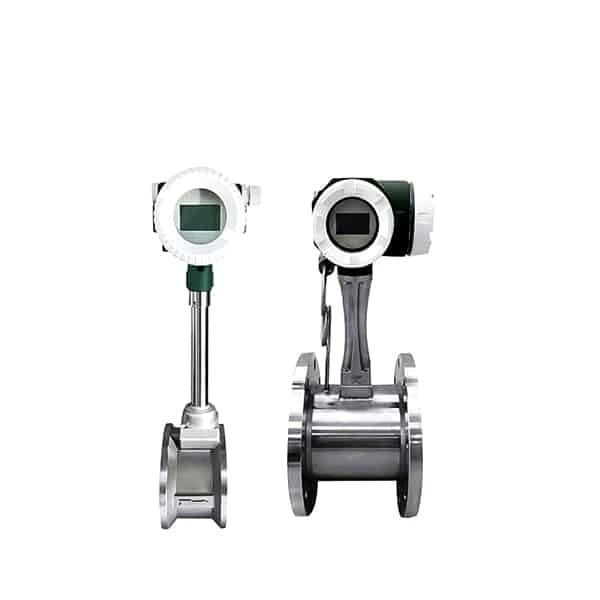 Vortex Flow Meter
General vortex selection for steam, gas, and liquid, DN15 to DN1000.
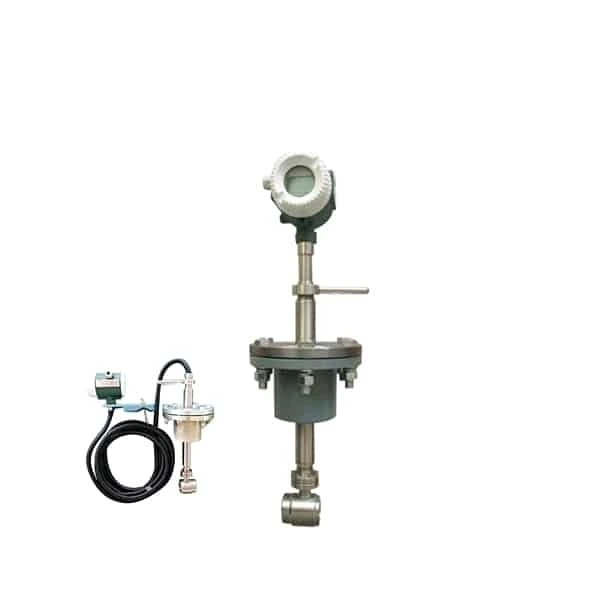 Insertion Vortex Flow Meter
For a large compressed-air main where a full-bore body is impractical.
Browse all vortex flow meters →
FAQ
How do you measure compressed air flow?
With a vortex or a thermal mass meter. A vortex meter counts the vortices a bar sheds and, with temperature and pressure, reports the air in standard volume; it is robust and suits a steady main. A thermal mass meter reads mass directly and down to low flow, which suits leak surveys.
Is a vortex or thermal mass meter better for compressed air?
It depends on the job. A vortex meter is robust, handles hot and wet air, and meters a steady header well, but it is weak below about 5 m/s, so it is a poor leak detector. A thermal mass meter has a wider turndown and reads low overnight flows, which suits energy and leak work. Many plants use both.
Does it read in standard volume (Nm3)?
Yes, with the temperature and pressure option. Air density moves with temperature and pressure, so the meter corrects it on board and totalizes in standard volume, Nm3/h, which is what cost and energy figures need.
What size and temperature does it cover?
DN15 to DN600, in a wafer or flange body, or an insertion probe for a large main. Standard builds run to 80 C, and a high-temperature build reads hot air to 400 C.
Request a quote
Send us the line size, the air pressure and temperature, and the flow range, and we set the body, the compensation, and the outputs.