Flow Meters › Vortex Flow Meters › Insertion Vortex Flow Meter
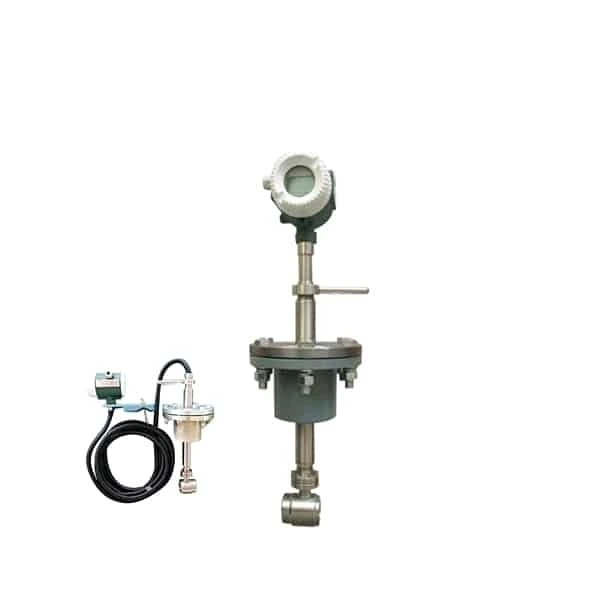
Insertion Vortex Flow Meter
A vortex flow meter on an insertion probe, for large ducts. The shedder bar sits on a rod that enters the pipe through a single tapping, so one meter fits DN150 to DN2000 without a full-bore body. It measures steam, gas, and liquid, and the probe can be hot-tapped into a line in service.
- Principle: Karman vortex shedding, insertion probe
- Size: DN150 to DN2000
- Accuracy: ±2.5% of rate
- Output: 4-20 mA, pulse, RS-485; battery option
- Rating: IP65 (IP68 submersible); Ex ia IIC T6 Ga
Overview
An insertion vortex flow meter puts the shedder bar on the end of a probe instead of inside a spool body. The probe enters the pipe through one tapping with a flange, the bar sheds a Karman vortex street into the flow, and the shedding frequency gives the local velocity, which the meter scales to the full-pipe flow. Because only a probe goes in, one meter covers a wide range of large pipe sizes, DN150 to DN2000, at a fraction of the cost and weight of a full-bore meter on a big duct.
It measures the same media as the full-bore meter, saturated and superheated steam, gas, and liquid, and the probe can be hot-tapped into a line that stays in service. The trade is accuracy: an insertion meter reads ±2.5% of rate, against ±1.0% to ±1.5% for the full-bore vortex flow meter, because it samples one point in the profile rather than the whole bore. For small and medium lines where full-bore accuracy matters, use the full-bore meter instead.
Features
Everything here follows from one fact: only a probe enters the pipe, so big ducts become practical.
One meter, DN150 to DN2000
A single probe covers a wide span of large pipe sizes, where a full-bore body is heavy and costly.
Hot-tap install
With a ball valve the probe goes in and comes out through one tapping while the line stays in service.
Steam, gas, and liquid
One probe measures saturated and superheated steam, compressed air and gas, and clean liquid.
No moving parts, low loss
A fixed bar in the flow means nothing wears, and the slim probe adds almost no pressure loss.
To 350 C, IP68 option
Temperature builds reach 350 C, and a submersible probe is sealed to IP68 for buried or wet pits.
4-20 mA, pulse, RS-485
An LCD head drives analog, pulse, and Modbus, with a 3.6 V lithium battery option for remote sites.
Working principle
The probe carries a bluff body, the shedder bar, that sits in the flow at a known depth in the pipe. As fluid passes the bar it sheds vortices alternately from each side, the Karman vortex street, and the shedding frequency is proportional to the local velocity. A piezoelectric sensor in the probe counts the frequency, and the meter scales the point velocity to the full-pipe flow from the known pipe bore and velocity profile. Because the meter samples one point rather than averaging the whole bore, it is set to ±2.5% of rate, and it needs a developed flow profile, so the same 40D upstream and 20D downstream of straight pipe apply. The slim probe means almost no pressure loss and an easy hot-tap install.
Technical specifications
| Parameter | Specification |
|---|---|
| Measurement principle | Karman vortex shedding, insertion probe |
| Medium | Saturated and superheated steam, gas, and liquid |
| Size | Insertion DN150 to DN2000 |
| Accuracy | ±2.5% of rate |
| Velocity range | Liquid 0.5 to 5 m/s; gas 6 to 50 m/s; steam 7 to 60 m/s |
| Medium temperature | -40 to 80, 250, or 350 C (by build) |
| Ambient temperature | -40 to 55 C, RH 5 to 90% |
| Nominal pressure | Liquid 1.6 to 4.0 MPa; gas and steam 1.6 to 2.5 MPa |
| Probe and rod | 304 standard; 316L on request |
| Connection | Pipe tapping with flange, GB 9119 1.6 to 4.0 MPa |
| Outputs | 4-20 mA; voltage pulse (high ≥5 V, low ≤1 V); RS-485 |
| Power | DC 12 V or 24 V; 3.6 V lithium battery for local display |
| Display | LCD: rate, total, vortex frequency |
| Structure | Integral, split, or submersible |
| Straight run | 40D upstream, 20D downstream |
| Protection | IP65; IP68 for submersible install |
| Explosion protection | Intrinsically safe Ex ia IIC T6 Ga |
Representative specifications; confirm per datasheet for the pipe size, medium, and temperature you need.
Ordering example. Insertion vortex flow meter for a DN600 compressed-air duct, 4-20 mA and RS-485, hot-tap flange with ball valve, Ex ia.
Measuring range
Like any vortex meter, it is sized by velocity, and the probe samples the local velocity. Keep the working velocity inside the band for the medium so vortex shedding stays strong.
| Medium | Velocity range | Note |
|---|---|---|
| Liquid | 0.5 to 5 m/s | Clean, low-viscosity liquid |
| Gas | 6 to 50 m/s | Compressed air and plant gas |
| Steam | 7 to 60 m/s | Saturated or superheated |
Insertion or full-bore
The insertion probe and the full-bore body share the same vortex sensing; the choice is pipe size against accuracy:
- Insertion (this page). DN150 to DN2000, ±2.5% of rate. One probe for large ducts, hot-tap install, lower cost and weight.
- Integral, split, or submersible. Head on the probe, head remote on a hot line, or an IP68 probe for buried and wet installs.
- Full-bore. DN15 to DN1000, ±1.0% to ±1.5% of rate, with optional temperature and pressure compensation for steam mass; see the vortex flow meter.
Applications
Insertion vortex meters suit big ducts where a full-bore meter is impractical:
- Compressed air and plant gas on large headers
- Combustion and process air, including air-separation ducts
- Saturated and superheated steam mains
- Flue and process gas on wide ducts
- Cooling and process water on large lines
Application example
Large air duct. A plant needed to meter air flow on a DN750 duct running tens of thousands of cubic meters per hour, where a full-bore meter that size would be heavy and expensive. An insertion vortex probe hot-tapped into the duct through one flanged tapping and gave the flow with almost no pressure loss, at a fraction of the cost of a full-bore body. The probe could be withdrawn through its ball valve for checking without shutting the duct.
Related products
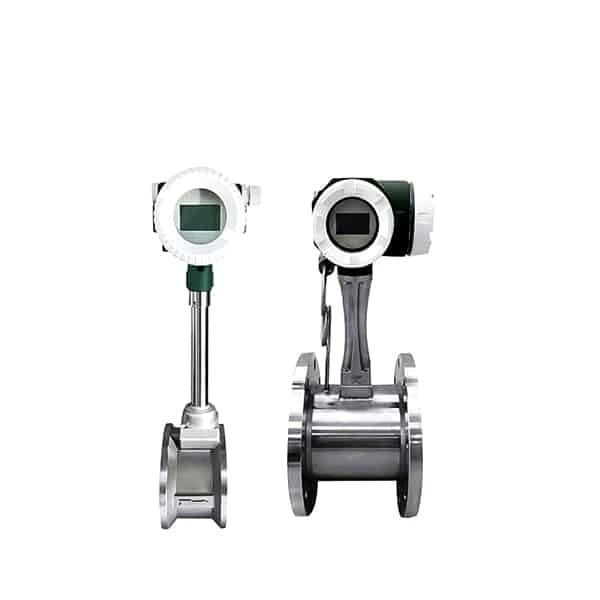 Vortex Flow Meter
Full-bore wafer or flange body, 1.0% to 1.5%, DN15 to DN1000.
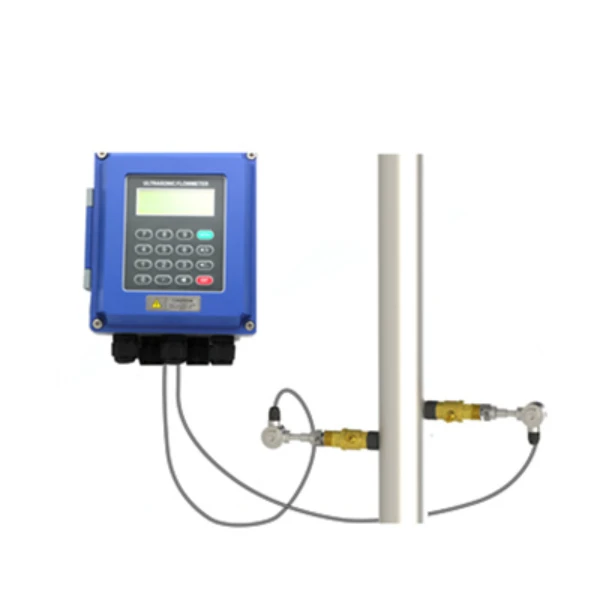 Insertion Ultrasonic Flow Meter
Insertion transit-time for clean liquid on large pipes.
Browse all vortex flow meters →
FAQ
What is an insertion vortex flow meter?
It is a vortex flow meter built on a probe rather than a full-bore body. The shedder bar enters the pipe through one tapping, sheds a Karman vortex street, and the shedding frequency gives the local velocity, which the meter scales to the full-pipe flow. One probe covers DN150 to DN2000.
How accurate is it compared with a full-bore vortex meter?
It reads ±2.5% of rate, against ±1.0% to ±1.5% for a full-bore vortex meter, because it samples one point in the flow profile rather than the whole bore. The trade buys a far lower cost on large ducts.
Can the probe be installed without shutting the line?
Yes. With a ball valve on the tapping, the probe is hot-tapped in and can be withdrawn for checking while the line stays in service. A submersible build is sealed to IP68 for buried or wet pits.
What media and sizes does it suit?
Saturated and superheated steam, gas, and clean liquid, on large pipes from DN150 to DN2000. For small and medium lines, or where you need better accuracy, use the full-bore vortex flow meter.
Request a quote
Send us the pipe size, the medium, the flow range, and the temperature and pressure, and we set the probe length, the structure, and the outputs.