Home › Pressure Instruments › SI-503K Gas Pressure Sensor
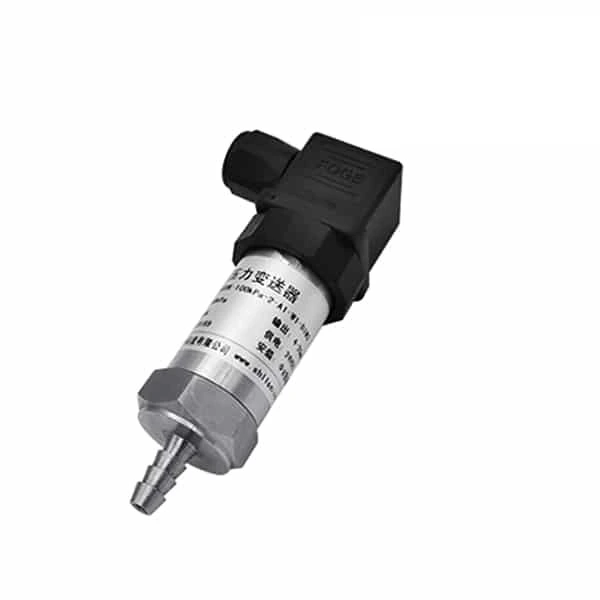
SI-503K Gas Pressure Sensor
A compact, all-stainless gas pressure transducer for natural gas, flue and exhaust gas, compressed air, and other dry or weakly corrosive gases. The Phi 8 pagoda nozzle pushes straight onto soft tubing, so it drops into OEM gas skids without an adapter.
- Range: -100 kPa to 0, up to 0–10 MPa (gauge and compound)
- Accuracy: 0.25% FS or 0.5% FS
- Output: 4–20 mA (2-wire); 0–5 / 1–5 / 0–10 V (3-wire)
- Wetted parts: 304 stainless steel, laser-welded
- Connection: Phi 8 pagoda quick-connect nozzle
- Protection: IP65
Bolt a general process transmitter onto a gas line and two things go wrong: the threaded port needs an adapter for the soft tube, and the price is built for liquids you never run. The SI-503K is sized for the gas job instead. It reads gauge or compound pressure from a few kPa up to 10 MPa, ships in 304 stainless, and ends in a Phi 8 pagoda barb that a silicone or PU tube slides straight onto.
Overview
The SI-503K is a strain-gauge gas pressure transducer built for natural gas, biogas, exhaust and flue gas, compressed air, and weakly corrosive gases or liquids that 304 stainless can hold. The whole wetted path is laser-welded stainless, so there is no soft seal to swell or leak on a gas line. It carries a high-precision bonded foil strain gauge, gives a 4–20 mA or voltage output, and runs off a standard 24 VDC supply.
Typical duty cycle is continuous monitoring or closed-loop control on a gas skid: burner trains, gas distribution headers, HVAC and air-conditioning lines, water-works air charging, and vehicle brake-air test rigs. Where the medium is genuinely corrosive (wet chlorine, strong acids), step up to a flush-diaphragm pressure sensor with a ceramic or coated cell instead.
Working principle
Gas enters through the pagoda nozzle and presses on a thin 304 stainless diaphragm. A bonded foil strain gauge on the back of that diaphragm changes resistance as the metal flexes, and a Wheatstone bridge turns the tiny resistance change into a millivolt signal. On-board electronics amplify and linearize it to 4–20 mA or a voltage. Because the diaphragm and body are one welded stainless piece, the gas never touches a fill fluid or an O-ring.
Technical specifications
Representative specifications, at room temperature and rated supply unless stated. Values typical; confirm the exact build per datasheet.
| Parameter | Specification |
|---|---|
| Measuring range | -100 kPa to 0 (compound) through 0–1 MPa up to 0–10 MPa gauge (10 MPa is about 1450 psi / 100 bar) |
| Comprehensive accuracy | 0.25% FS or 0.5% FS |
| Output signal | 4–20 mA (2-wire); 0–5 V, 1–5 V, or 0–10 V (3-wire) |
| Supply voltage | 24 VDC nominal (9–36 VDC) |
| Medium temperature | -20 to +105 °C |
| Ambient temperature | -20 to +85 °C |
| Load resistance | Current output ≤ 800 ohm; voltage output ≥ 50 kohm |
| Insulation resistance | ≥ 2000 Mohm at 100 VDC |
| Response time | < 1 ms |
| Long-term stability | 0.1% FS per year |
| Vibration | 20–1000 Hz, output change < 0.1% FS |
| Protection | IP65 |
| Wetted material | 304 stainless steel, laser-welded |
| Electrical connection | Hirschmann (DIN 43650) connector, optional |
| Process connection | Phi 8 pagoda quick-connect nozzle; threaded options on request |
Output and wiring
Pick the output by the distance and the input card on your controller. The 4–20 mA loop is the safe default for any run longer than a few meters: it is a 2-wire current loop, so cable resistance and electrical noise do not shift the reading, as long as the loop load stays at or below 800 ohm. The voltage versions (0–5, 1–5, 0–10 V) are 3-wire and suit short runs into a PLC analog input with a high-impedance load above 50 kohm. A 1–5 V or 4–20 mA span also gives you a live-zero, so a broken wire reads as a fault instead of a true zero.
Selecting the range
Size the range to the working pressure, not to the worst case the line could ever see. For a sensor read in percent of full scale, a span you mostly use at 30–80% gives you the best resolution and the smallest error in real numbers.
Two range families cover most gas work. A compound range (-100 kPa to 0, or -100 kPa to a positive value) is the one to pick when the line can pull a vacuum, for example a gas blower suction or a pump-down step. A plain gauge range (0–1 MPa, 0–2.5 MPa, up to 0–10 MPa) covers positive pressures: 0–1 MPa is about 0–145 psi, and 10 MPa is about 1450 psi or 100 bar. For very low air or draft pressures in the kPa or inches-water range, a dedicated low pressure transducer resolves the small span far better than a 10 MPa unit turned down.
Applications
The SI-503K shows up wherever a gas or clean-air line needs a rugged, low-cost pressure reading:
- Natural gas and biogas distribution headers and burner trains
- Exhaust and flue-gas back-pressure monitoring
- Compressed air and HVAC / air-conditioning charge pressure
- Water-works and water-conservancy air-charging and pump skids
- Chemical and medical gas lines running dry, weakly corrosive media
- Vehicle brake-air and pneumatic test benches
Application example
Industrial gas supplier, compressed-air skid. A specialty-gas supplier was building an air skid around a mass flow controller and needed a compact pressure element on the supply side, in stainless, that would push onto the existing tubing without a new fitting. We quoted the SI-503K with the Phi 8 nozzle and a 4–20 mA loop into the skid controller, in 304 stainless for the clean dry-air service. It went forward as the pressure element on the skid.
FAQ
What does a gas pressure sensor do?
It measures the pressure of a gas and converts it to a 4–20 mA (or voltage) signal. The SI-503K measures industrial gas pressure, such as compressed air or process gas, on its sensing diaphragm and reports it for monitoring or control.
Where is a gas pressure sensor located?
At the gas tapping point: it mounts on the pipe, manifold, or vessel through its process connection so the diaphragm sees the gas directly, away from liquid traps where possible.
Related products
 Pressure Transmitters
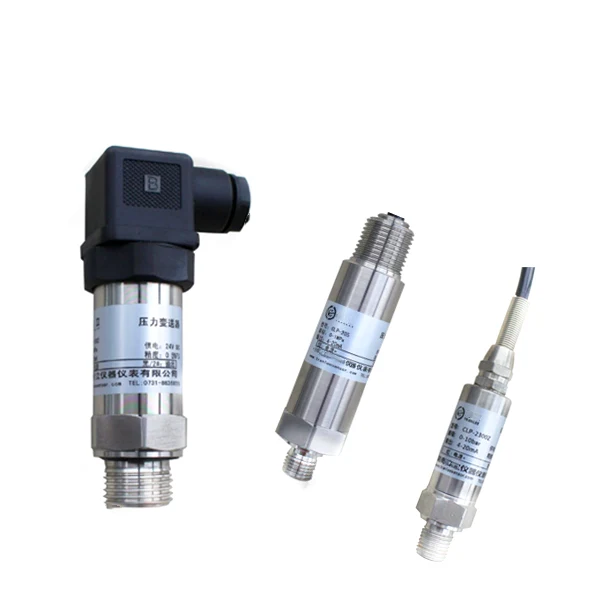
The general-purpose SI-300 series for liquids, gases, and steam on threaded process ports.
 Silicon Pressure Sensor
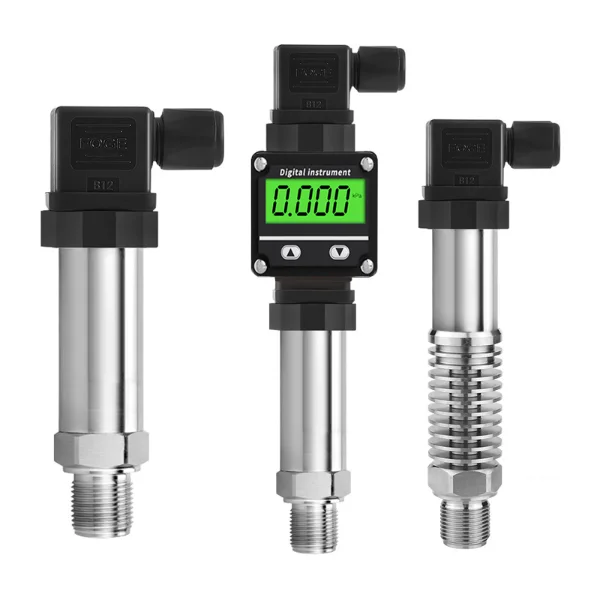
Low-cost diffused-silicon core for OEM gas and liquid pressure at higher volumes.
 Flush Diaphragm Pressure Sensors
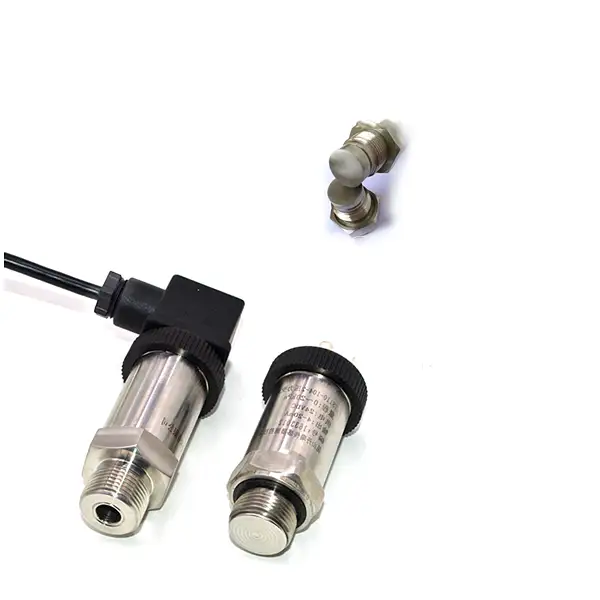
Flush-mount cell for viscous, sticky, or more corrosive media that would clog a nozzle.
Browse all pressure instruments →
Request a quote
Tell us five things and we configure one unit, not a shelf part:
- Gas or medium (natural gas, biogas, exhaust, compressed air, other)
- Pressure range you actually run, and whether it can pull a vacuum
- Accuracy needed (0.25% or 0.5% FS)
- Output and supply (4–20 mA or which voltage; 24 VDC)
- Connection (Phi 8 nozzle or a thread, plus Hirschmann or cable)
Ordering example: SI-503K, range 0–1 MPa gauge, 0.5% FS, 4–20 mA 2-wire, Phi 8 pagoda nozzle, Hirschmann connector, 24 VDC.
Tell us the application and we configure one unit, not a shelf part. Questions on a gas line we have not listed? Reach our application engineers.